Physical State of Matt Interlude: PERU
Updated: May 18
I wasn’t going to write about this trip. I had been planning to stay present and just experience it, but I quickly realized it was going to be too good not to share. So this has nothing to do with the 50 States, but I hope you'll indulge me.

Truth be told, I had been dreading this trip. For reasons she’s somehow forgotten, my high school bestie and co-instigator Larissa got it in her head that before she turned “milestone birthday” (as she says), she and her husband Jamien were going to do this 40-mile, five-day hike through the Andes, ending with Machu Picchu. Was I in?
Being more adventurous than smart, I said “hell yes!”. I’m not exactly Mr. Endurance Fitness Guy, so I spent the months before worrying if my body would make it.

I’d never hiked at altitude before. This hike’s high point was 15,200 feet. For context, that’s 700 feet higher than Mount Whitney, the tallest mountain in the contiguous US. As a former smoker, how would my lungs hold up - had I done lasting damage to them? Would I get to the top and then flop around on the ground, gasping like a fish out of water?
I've had janky knees since growing too fast as a teenager. Would they blow up on the side of a mountain miles from civilization?
And finally, I have a back that’s prone to going out, part of the joys of being 6'4" in a world not built for me. Besides, I had just turned “milestone birthday” myself, and my body is beginning to feel the mileage.
I spent the month leading up to the trip at the gym, but I wasn’t really ready. If my lungs, knees, and back held together I was confident I could make it, but yeah - I had nerves.

Our flight was from Newark to Cusco with stops in Atlanta and Lima. The first two legs were uneventful, but our flight to Lima got in too late to make a connection, so we had to spend the night in the airport. We found some benches at the far end of a terminal without armrests and were able to get a little uncomfortable sleep. We awoke to find that our flight to Cusco was departing from the gate right in front of us. It could have been much worse.
The flight to Cusco was less than two hours. At the midpoint the pilot got on the intercom and recommended we look out the windows. Dawn was casting its orange glow on the snow-capped peaks of the Andes range below us.

CUSCO
Cusco is a city of about half a million tucked away in the mountains at 11,000 feet. It’s one of the Americas’ longest continuously inhabited cities, and was declared a UNESCO World Heritage Site in 1983. Its Quechua (CATCH-oo-uh) name - Qusqo - means “Navel of the World”. Quechua was the official language of the Inca civilization and is still spoken by roughly 5 million Peruvians (~15% of the population), and 8-10 million worldwide.

Cusco was the capital of the Inca civilization from the 12th century up until the Spanish conquistadors destroyed their culture in the 16th. Our guide on the trip informed us that he doesn't like the term “Inca Empire” since he views the term “empire” as European and the Inca civilization pre-dates even the use of the word. So I’ll refrain from calling it that.
As was recommended, we arrived in Cusco a few days before the trek to acclimate to the altitude. We had also gotten prescriptions for Diamox. We also partook of the local remedy for altitude sickness - coca tea. I was pleased to find that I was able to breathe fine when resting or casually strolling. Going up stairs however, we would find ourselves immediately out of breath.
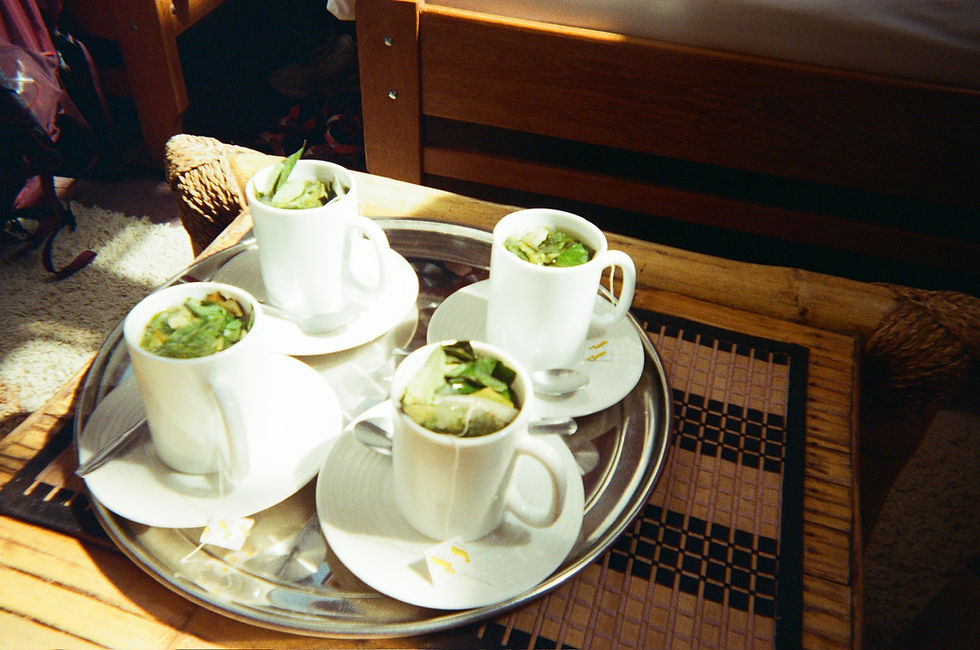
Yes, coca is the same plant that cocaine is made from, and the leaves are illegal in the US, but if it gave me any energy boost at all, it wasn’t any more than green tea. It’s just a matter of concentration - like the difference between the water that comes out of maple trees and maple syrup. Not the same thing at all.
The part of Cusco we stayed in was gorgeous, and clearly the main tourism area of the city. It was a short walk uphill to the Plaza de Armas (my second favorite de Armas after Ana), a grassy square ringed with Spanish architecture churches, alpaca clothing shops, and restaurants.

In the center is a fountain with a sculpture of Pachacuti, the 11th Inca. Although it’s a common term, I don’t say “Inca Emperor” because we learned, again from our trek guide, that the rulers themselves were called Incas. The Inca civilization was all the people ruled by the Incas. So “Inca Emperor” is like saying “King President”.

Dozens of people walked the square hawking tours, massages, art, or trinkets. Peruvian women dressed in traditional garb carried baby alpacas charging for pictures. As prevalent as the salesmanship was, I appreciated that no one was overly pushy.
On our second day we decided to make the trek uphill to visit Christo Blanco (a name I found endlessly amusing), Cusco’s smaller version of Rio’s Christ The Redeemer statue. It was only about a mile from Plaza de Armas, but that mile took us up innumerable stairs with an elevation gain of over 500 feet. Normally this would be a bit of a challenge but no big deal. Fresh to the altitude as we were though, it kicked our asses.

Every 25 or so steps we had to stop for a moment to catch our breath. It was a strange sensation. We’d get winded almost immediately, but 30 seconds of rest and we were just fine. Chunk by chunk we made our sweaty way up the hill to the statue. Although roughly 25% the height of Rio’s statue, Christo Blanco is still 8 meters tall and was impressive up close.

The city, a sea of terracotta roofs, stretched out below us completely covering the valley floor.

A ten minute walk further on was Sacsayhuamán, a famous Inca site. The name comes from the Quechua “saksay waman pukara”, which means roughly "Fortress of the Satiated Falcon/Hawk”. We used the mnemonic device “sexy woman” to remember the name and pronunciation.

Massive stone walls and the remnants of dozens of buildings surround a wide grassy plaza that was used as a communal gathering space. What makes Sacsayhuamán, and Inca architecture in general, so impressive is the incomprehensible stonework. The stones are gargantuan. The largest stone at Sacsayhuamán is estimated to weigh somewhere between 125 and 200 tons.

What’s crazier is the stones were moved uphill from quarries 20 kilometers away. This becomes more mind blowing when you learn that the Incas didn’t use wheels. Ancient Inca toys were discovered with wheels, so it's not like they didn’t understand the concept. There is just no evidence that they used wheeled carts for moving things around. It’s believed the mountainous landscape made the use wheels so impractical they didn’t.

Another truly remarkable thing is that the Incas made these stones fit together so perfectly that they didn’t have to use mortar. And the walls are still standing - in a highly seismic area - over half a millennium later.

In order to fit snugly, stones were chiseled into odd shapes. The most famous example is the Twelve Angle Stone, which is part of a wall in an alley that was just a few blocks from our hotel (random stranger’s shoulder for scale).
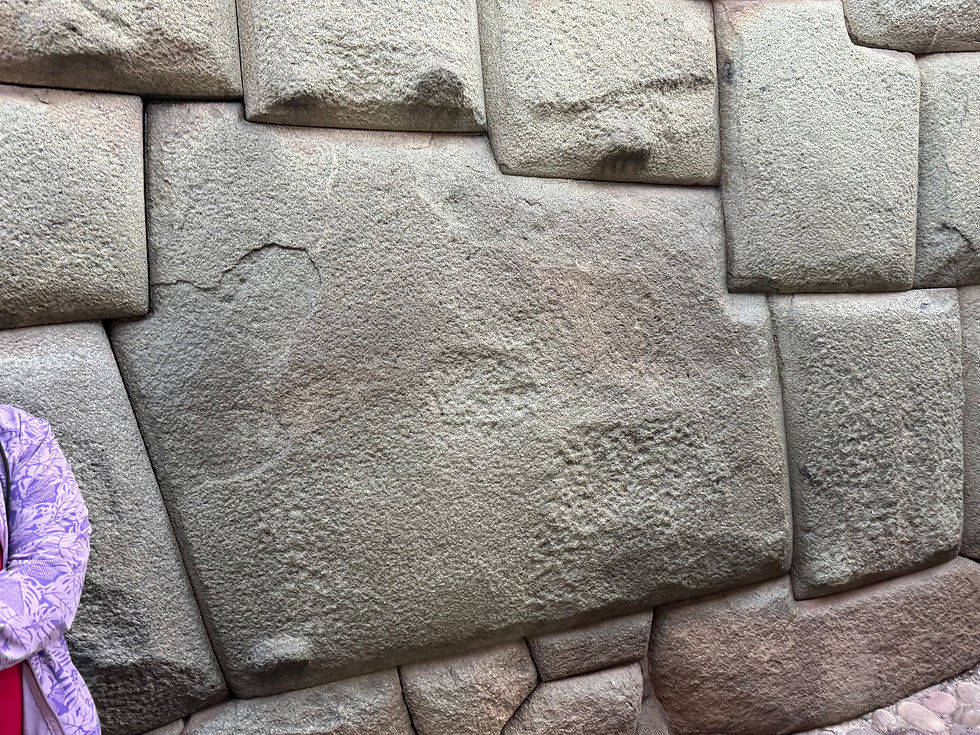
The advanced engineering required to perfectly fit stones weighing dozens of tons together using 15th century technology boggles the mind, and baffled historians for ages.
After wandering through the site for a while, jet-lagged and tired from the climb, I lay in the grassy plaza for a while. A hundred tourists milled about, and a herd of about 20 alpacas frolicked.
One randy and particularly inept alpaca tried to make moves on another. Initially he attempted this sideways, but eventually they figured it out and had a presumably successful love making session on the ground.

A quick note on alpacas and llamas because I didn’t know the difference. They are not the same thing, but very closely related species. Alpacas are smaller and shyer, preferring herds. They were bred for their fine wool, which is used to make deliciously soft clothing.
Llamas are bigger, more independent, and bolder - in fact they can be downright ornery. They’re notorious for spitting at people that piss them off. They are often used as guard animals for alpaca herds or other livestock. Their wool is coarser and used mostly for things other than clothing. Wild alpacas are vicuña and wild llamas are guanaco. If a llama and alpaca breed they produce a huarizo (or llapaca)

FOOD
Over the course of four days, we didn’t have a single bad meal. Peruvian food is simply incredible. Trout is a big ingredient in Cusco, usually served grilled or as ceviche. It’s not like the trout you get in the US however. The meat is light pink like pale salmon.
Tiger’s milk ceviche was a stunner. Fresh hunks of fish with a sharp and spicy citrus marinade that is made white with coconut milk. No tigers were harmed in the writing of this blog. I can’t however say the same for alpacas and (I’m going to lose some of you here) guinea pigs.

Alpaca is a lean, mild flavored red meat similar to beef. I expected it to be gamey, but it wasn’t at all. The guinea pig, or cuy (QUEE) was incredible. The flavor, fattiness, and crispy skin reminded me most of duck. They have been common in Peruvian cooking for many centuries. Tens of millions of them are raised each year for meat.

Chinchilla, another small furry rodent kept in the US as pets, is also a traditional meat. Our guide said that’s really only the case for people living in the mountains who catch them wild. They’re not bred for eating.

The Cathedral Basilica of the Assumption, one of the churches on Plaza de Armas, has a painting of the last supper done in 1753 by Marcos Zapata. This one depicts a traditional Peruvian meal on the table - its centerpiece a roasted chinchilla.

Apologies to all the squeamish Americans who had guinea pigs as pets and couldn’t imagine eating one, but I really enjoyed it. One restaurant where we ate had whole roasted cuy on the menu. After cooking, they would bring it out to the table whole for pictures, then take it back to the kitchen to portion it for consumption. We didn’t order one, but the table next to us did. They were excited as it came out, but after it was taken away their faces looked as if they wished they hadn’t seen it that way.
I also ate goat heart served anticucho style.

The closest thing we had to a poor dining experience happened one of the nights in Cusco when I found a bent metal rivet the size of a small marble in my ceviche. Thankfully I didn’t bite down on it, and they comped our whole meal, so I was happy. The biggest food challenge we faced was not drinking the water.

Drinking bottled water wasn’t a problem, but it was so hard to remember using bottled water to brush my teeth. It’s recommended for Americans visiting Peru and we didn’t want to take any chances with our digestive systems before being on the mountain for five days.

The last food of note I bought in Peru but didn’t try until I got back to the US. This is the very special “coati coffee”. As we learned on our trek, fresh coffee beans are not actually beans at all but the seeds at the center of fruit called the “coffee cherry”. The ripe fruit has a pulpy red outside. Inside this fruit and through two shell-like layers lies the seed which is dried, roasted, ground, and turned into the bitter nectar of life.

Coatis are closely related to raccoons, but have longer snouts and tails. Coatis love the red fruit of coffee cherries. They eat them right off the plant, digest the fruit layer and shit out the center of them whole. You can probably guess where I’m going with this…
These coati poops are gathered, the beans are separated out then processed. The resulting coffee is rare and crazy expensive, but is supposedly the best. It is said to have a full-bodied, nutty (god help me) flavor that is less bitter and acidic than regular coffee.
I made a small batch when I got home, but I think it requires a higher bean to water ratio than I’m used to. The coffee turned out rather weak so I’m not able to properly confirm or deny these reports at this time.
ORIENTATION
We met at the offices of Salkantay Trekking for orientation the night before they were to pick us up. We met our incredible guide Guido (pronounced “gee-do” with a hard G, not like the derogatory term for Italian Americans). We signed waivers presumably saying if we keeled over from a heart attack or pitched off the side of the mountain, they weren't liable.

We also got to meet the others in our hiking group. They were four Americans in their mid-twenties who were doing this trek for a bachelorette party. They were Kristina (the bride-to-be), Maria, Claire, and Morgan. We got to know them over the next five days and they are all impressive young women.
Each of them are very accomplished professionally considering their age. They are also focused on personal projects creating in-person community to combat the loneliness epidemic young people in the US face. Dare I say, they gave us renewed hope for Gen-Z (uggh I sound so old).
Guido walked us through a high-level overview of the trip:
Day 1 was the warm up. Bus to Challacancha (12,467 ft), hike to Saraypampa Sky Camp (12,795 ft), then an out-and-back to Humantay Lake (13,780 ft). Total distance: 6.2 miles.
Day 2 was the brutal one. I’d had it circled for months. Hike from Sky Camp (12,790 ft) 4 miles up to the Salkantay Mountain Pass (15,190 ft), then back down the other side and into the cloud forest, ending at Collpapampa Mountain Sky View (9,600 ft). Total distance: 14.6 miles.
Day 3 continue the descent, moving from cloud forest to rain forest. Stops at a maracuya (passionfruit) plantation, and a “Coffee Experience”. Ending at Lucmabamba Jungle Domes (6,562 ft). Total distance: 6.4 miles.
Day 4 we were going to get a reprieve. Landslides the week prior had closed several sections of road and hiking trail, so what was supposed to be an 8.7 mile day became much shorter with shuttle vans and a train between key points. Frankly, I was relieved. Stay the night in Aguas Calientes (6,693 ft), the small city that is the gateway to Machu Picchu.
Day 5 bus to Machu Picchu (7,972 ft), tour for four hours, then back to Aguas Calientes, train to the Sacred Valley of the Incas, and shuttle van back to Cusco.
Orientation complete, we headed back to the hotel for an early bedtime prior to our 4:30am pick up.
Okay, a quick disclaimer: This trip was not Man vs. Wild. We did not spend nights wedged between rocks in sleeping bags at the top of the mountain. We had opted for the Premium tour. This was glamping of the first order with mules carrying most of our gear, a crew cooking us three feasts a day, and brand new accommodations that were unbelievably nice, especially considering they were so remote.

That said, as cushy as it was, we still had to show up and do the work. This wasn’t some Mount Everest shit, but it was really challenging (certainly for us olds). If we absolutely couldn’t hack it, we could hire horses to carry us through the hardest parts of Day 2, but we were damned if we were going to ride the “fail horse”.

So judge me all you want as I proceed to whinge about how much my muscles ached while I gazed through a glass dome at the stars in my king-sized bed. It was the hardest physical thing I’ve ever done, and I’m proud of it.
DAY 1
The shuttle van picked us up the next morning right on time. An hour and a half driving on mountain roads that got more and more narrow, and we stopped at a restaurant in the small town of Mollepata for breakfast.

In addition to being naturally a little antisocial in the morning, I was nervous. So I popped my earbuds in and listened to ska punk to hype me up. Thirty minutes later, when we arrived at our starting point, I bounced out of the van ready to go. Then I looked up.

The narrow path was a switchback straight up a nearly vertical hill. So much for easing in, but I could do this! A few other tour groups had unloaded at the same spot, and one by one they trudged along. I had pictured the hike as relatively solitary, but over the course of Days 1 and 2 we shared the path with hundreds of other hikers. Guido explained that in the last 10 years hiking tourism there had exploded.
Guido gave us a little motivational speech and tasked us with creating a name for our group. Then we shouldered our day packs, extended the hiking poles they had provided, and started up.

Our lungs screamed out for oxygen immediately. I was embarrassed at how quickly I was gassed, but encouraged that it wasn’t just me. When I took my first rest I looked down and we’d barely made any progress. Thirty excruciating minutes later I was relieved when the path flattened out about 400 feet up from where we’d started. We were now eye level with the fluffy clouds that had settled between the sheer mountains around us.

For the next few miles we wound our way along a flat path that bordered a concrete channel that brings water to villages down the mountain. Despite the fact that there was a light drizzle, the channel was nearly dry. Guido explained that the channel had been blocked by a landslide, which were a regular occurrence. The locals hadn’t dug the channel out and repaired it yet.

He stopped us regularly to explain what life was like living in the mountains. Potatoes are a key crop for Peruvians. They have over 4,000 different variations. Nearly every meal we ate had potatoes - mashed, fried, roasted, white, purple, grainy, creamy - and they were all delicious.
Corn is also a staple in Peru. In addition to every preparation you could think of, there is a sweet bright purple drink made from corn that is available at nearly every restaurant called chicha morada.
He also explained that they cultivated lupins - the purple wildflowers I saw in the ditches in Minnesota - as a crop. The plants have bean pods that are edible, and it’s an important part of the diet in the mountains.
Narrow waterfalls poured water hundreds of feet down the side of the mountain alongside us.

After a couple of hours we arrived at Sky Camp, where we’d be spending the night.There was a main gathering hall and kitchen in the center of twenty igloo-shaped cabins. Next to that was a stable and tiny store with snacks. A wide open field with dozens of horses stretched out beyond that with a wide path heading up Humantay Mountain. This was our next leg. Salkantay Mountain, where we would be hiking tomorrow, was shrouded by thick clouds.

Guido passed out sleeping bags, liners, and the duffles that had been driven up a different way. We were paired up for accommodations. Our group had an odd number of people. Four friends, a married couple, and me. So I got to bunk solo. I know, boo-hoo I was really roughing it.

We dropped our gear in our igloos. Their ceilings were glass, looking up at the wide sky. Little constellation maps had been left for us. The entrance was perhaps three feet tall, which made entering and exiting comical for me.
We gathered for lunch and met our cooking crew - Urbano the chef, Edgar the sous chef, and Christian their helper. They then brought us the most ridiculous feast. We had burned a lot of calories and were hungry, but just when we were stuffed and thought we were done they brought out more. Groups usually have twelve people, and I swear they still cooked for twelve. It was all fantastic. Stuffed to the gills, we were given a half hour to digest, then we’d be off to Humantay Lake.

We surveyed the path ahead. It looked like a gradual incline up Humantay mountain, which peeked out through the clouds. The string of people already hiking made their way up, then hooked left out of view. Around the place where they went out of sight, a small stream flowed off the flat hilltop. That must be where the lake was, I reasoned. This should be fine.

We set off through the horses. As before, I was breathing hard after three steps despite the gradual climb, but I set my sight on the bend in the path - no problem. I was huffing and puffing hard but feeling victorious when I rounded the bend and the ground flattened out. But there was no lake. In fact, the path continued up even more steeply. I was only actually a third of the way. Nothing to do but keep going, so on I went.

At this point, our group had stretched out. The girls were out front and we were straggling behind. This was a recurring theme. To be fair, they had 25-year old knees and Kristina had done a half Iron Man race the year prior, so although I am a competitive person, I accepted the reality easily. As soon as I crested the final hill and saw the lake the fatigue left me completely.

The glacial water was the most unreal turquoise - like nothing I’d ever seen. The snow gathers glacial flour (finely ground rock and minerals) as it melts and runs into the lake. This, and a special algae, is what creates the shocking color.

Forty other hikers walked the shore and posed for pictures. Two wild cows (I’d never seen wild cows) expertly navigated the steel slope to drink from the lake.

Ten years ago, Guido said, he’d come up here and there’d be maybe a couple of people, but now…social media. The new tourism brings good money to the local economy and employs him, so if he had any sadness about the change he hid it well.

We lingered for an hour, taking our own pictures and soaking in the natural beauty. Looking back down the mountain the way we’d come, we could see the faintest band of a rainbow. Then, too soon it seemed, we were heading back down to camp.

The way down was much easier, but in the last stretch my knees started aching. Uphill is not a problem for me. I use my thighs and glutes to push myself up, and those muscles are decently strong. Downhill is the issue. The hiking poles helped me absorb some of my weight with my arms and shoulders, but there was no way around it - my knees got worked.
When we reached Sky Camp we looked up and the clouds over Salkantay Mountain had cleared. We could see the full peak in all of its majestic beauty.

After some downtime we had another massive meal. I don’t know how we were able to eat again, but we did. We packed ourselves to capacity but still felt guilty about how much food we were leaving on the platters. Thankfully, we were assured it wouldn’t go to waste.
Just as we were about to go back to our rooms, the chefs came out with hot water bottles for each of us. I mean, come on.

Honestly I felt almost embarrassed by how much we were being pampered, but it was cold that night in our unheated igloos, even fully dressed in our sleeping bags and liners. I was exceedingly grateful for my little bundle of warmth.
At 10:00 the camp’s power was shut off and we were able to see the ocean of twinkling stars above us. How special the day had been - and I’d survived.

DAY 2
I had fitful sleep that night filled with violent and disturbing nightmares that included my former partner. I almost never remember my dreams, and they were so vivid that I texted her first thing in the morning to make sure she was okay. Jamien had dreams of drowning and asphyxiation so vivid they woke him up several times.
We assumed that Jamien’s were caused by the altitude. Claire, a registered nurse, seemed to confirm that. She said that overnight her biomonitoring jewelry had said her blood oxygen level was down to 88% - well below the 94% where they would typically give patients an oxygen tube.
However, after discussing our dreams over a heaping breakfast it came to light that one of the side effects of Diamox, the medication we were taking for altitude sickness, was vivid nightmares.
As we geared up to go, Claire passed out Jolly Ranchers to everyone. We decided Jolly Ranchers would be a good group name. Guido misheard us, thinking we said Jolly Adventurers, and that stuck.
I spent the morning telling myself that maybe, just maybe, all of the hype about Day 2 was just that - hype. Day 1 had been tough, but I felt fine. maybe it wasn't going to be all that bad. Self-delusion is a wonderful thing.
Salkantay mountain stared down on us, imposing in the dawn light. Thankfully we weren’t planning to summit it - or anything even close.

The first recorded climb to the top of the mountain was in 1952. Salkantay’s peak is a towering 20,574 feet. However, Salkantay is only the 12th tallest mountain in Peru. The Salkantay Pass, which we were going over, was at 15,190 feet, two and a half times higher than I’d ever been.

The four miles up to the pass were broken into three sections, each one steeper than the last. We shared the path with dozens of hikers, all moving slowly, and a surprising number of mules and horses, carrying gear and moving much more quickly.
I have a newfound respect for hoofed animals after this trip, having watched them navigate the rocky terrain. We were instructed that when mules or horses came past us on a narrow section we were to move off the path on the uphill side because otherwise they were liable to shoulder us right off a cliff without a second thought.

The path became littered with uneven rocks ranging in size from baseballs to suitcases. In addition, there were frequent, fresh horse pies to avoid. We kept our eyes trained on the ground ahead of us so we didn’t twist an ankle or step in a pile of warm shit. Besides, looking up and seeing how far we still had to go was demoralizing.

Around the first stop, the path forked. The Salkantay Pass trail continued right, and the Inca Trail went left and switchbacked straight up. The Inca Trail is a more strenuous hike, and winds its way all the way directly to the top of Machu Picchu. At that moment I was so glad we hadn’t opted for that package. And to think, thousands used to cruise along that trail like it was no big thing as they made their pilgrimages to Machu Picchu. Bonkers.

At the second stop, Guido busted out the coca leaves to give us a little boost of energy and help with the altitude. For whatever reason I had imagined they would be fresh but they were dried. He handed out a cheekful for each of us. The leaves tasted like hay, which wasn't bad. He then gave us each a tiny chunk of hash (not that kind) for flavor made with banana flowers and mint. It was a delicious combo.

The air got thinner the higher we went, and it took a force of will to make it up the last stretch. 5-10 steps, pause, 5-10 steps, pause. As we neared the top, it began to drizzle, then sleet. Mercifully, it wasn’t too windy.

I finally dragged myself to the top and collapsed on a rock. I pulled out the waterproof gear I hadn’t had the foresight to don in the morning. And there was Urbano smiling with a hot cup of tea and a little chicken sandwich for each of us.
Think about that: This man woke up god knows when, cooked us breakfast, cleaned up after breakfast, then hiked past us with a full thermos on his back, and served us tea at the pass. Peruvians are astounding.

We sipped and chewed and absorbed the moment. The uphill portion of the journey was behind us, and we were still standing. We took pictures at the pass sign and started downhill.

We picked our way through the rocky terrain, watching for landmines, and now stepping over the streams that had begun running through the middle of the path. The landscape was shrouded in a dreamlike fog. Fog hell, we were in the clouds. Through the clouds, we passed fields littered with bright red rocks and mossy terrain with boulders the size of minivans. None of the pictures came out so I stopped taking them. It would have been nice to have a clear view, but I didn’t mind - this was all part of the experience. Hopefully we’d get clear weather at Machu Picchu.
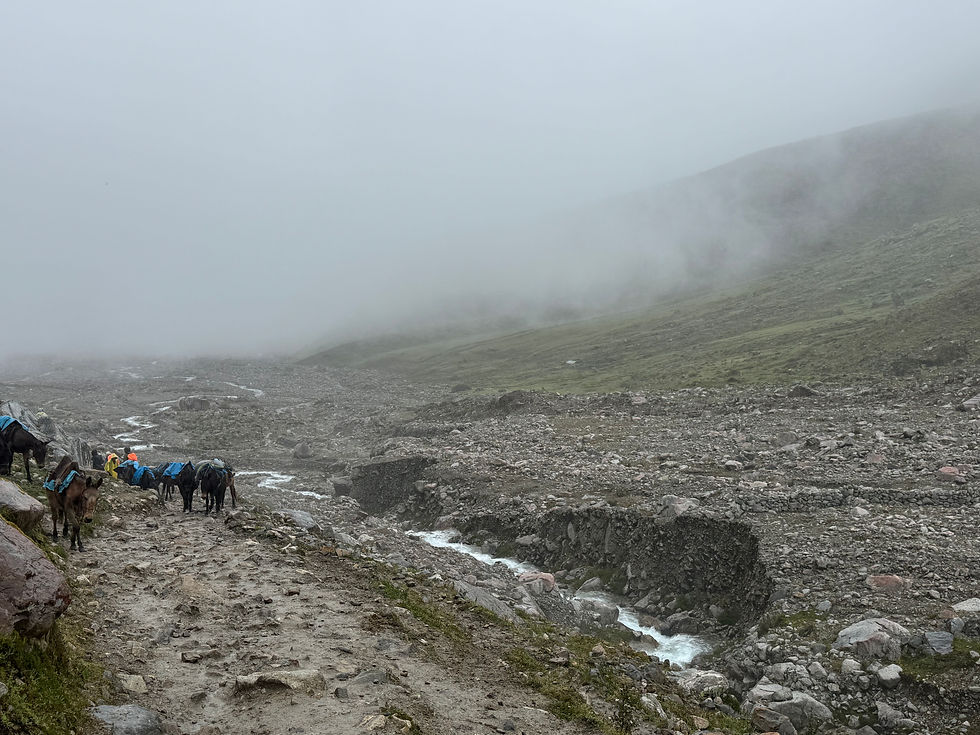
My knees were throbbing by the time we crawled into our lunch tent and finally sat down. I was grateful that I’d purchased new knee braces for the trip. I don’t think I would have made it otherwise. My phone said I’d walked almost ten miles, so we must be more than halfway, right? Right?

After lunch I tried having a conversation with Claire while we walked. It quickly became apparent that I couldn’t both keep up with her and give my footing enough attention so that I didn’t kill myself. After a few minutes all five feet of her went cruising on ahead, leaving me in the dust. Humbling.

Eventually we made it down into the cloud forest ecosystem. The landscape became suddenly lush, it stopped drizzling and the air warmed up considerably. We shed our layers.

In addition to the treacherous rocks, the path became a thick slurry of mud and horse shit. For long stretches, the path dropped precariously off to the right, so when one of the many mule teams pushed by us, we remembered the advice to stay uphill from them.

The landscape was breathtaking, but the next several hours were a slog. Each step down my knees felt the strain. I tried taking as much of my weight on the poles as I could.
We finally saw our destination ahead of us on the opposite side of the canyon. We were excited to finally know where the end was, but it was still so far away.

Guido came walking up the path toward us. He had left the girls at the bottom of the hill and doubled back for us. It was a little embarrassing, but I told him through gritted teeth that I was moving just as fast as I could safely. He mercifully spared us his wonderful educational talks on Day 2 and just let us get through it.
Eventually we got to the bottom of the hill and found the four girls sipping beverages outside of a primitive cafe. They charitably said they’d only been waiting for us fifteen minutes, but we knew that was bullshit. The last half mile was flat and much more manageable. Yes, we were exhausted, but the downhill pressure was off.

With our last bit of energy we climbed the stairs past the giant Inca head statue to Mountain Sky View.

The cabins here were a major step up from the igloos. Half of them were glass, looking out over the valley.

And there were showers with hot water. Hot. Water. Better yet, Guido told us there were beers for sale. I’m not proud of it, but I may have sat for several minutes on the shower floor, hot water cascading on my head, cuddling a cold liter of Pilsen. My phone said I'd walked 17 miles, but I'd done it!

DAY 3
Nightmares plagued me again that night. Just as violent and weird as the night before, but this time they involved Ethan Hawke, Michael B. Jordan, and Julia Garner. Don’t ask, I have no idea.
I had also gotten up to pee what felt like thirty times during the night. I had been trying to stay hydrated, but what the hell? Over breakfast I learned that frequent urination is also a side effect of Diamox. I stopped taking it.
Day 3 felt like a breeze. I still walked 11.5 miles, but it was a steady, gradual downhill on a smooth, wide path. No problem. I will cop to the fact however that every time I stopped walking for more than a minute or two my muscles ached like hell. I was fine as long as I kept moving.

Throughout the day, Guido told us about the local plants, the history of the Incas, and what it was like for him growing up in the area. At one point he stopped, picked some bright purple berries, and mashed them in his hand. These berries, he said, were one of the many natural dyes the Incas used for their textiles. They were also used to paint the faces of Inca warriors.
He then proceeded to paint designs on our faces with the berries. The designs would only last 4-5 days, he said with his little laugh. Guido was hilarious, but his delivery was such that I could never initially tell when he was joking. The designs sweat off in a few hours.

Eventually we passed below the cloud forest zone and into the rainforest. We were at the end of the Andes that became, not too far from us, the Peruvian Amazon. We hiked all day pretty much on our own. Other groups had broken off on different paths, so it was just us and very chill.
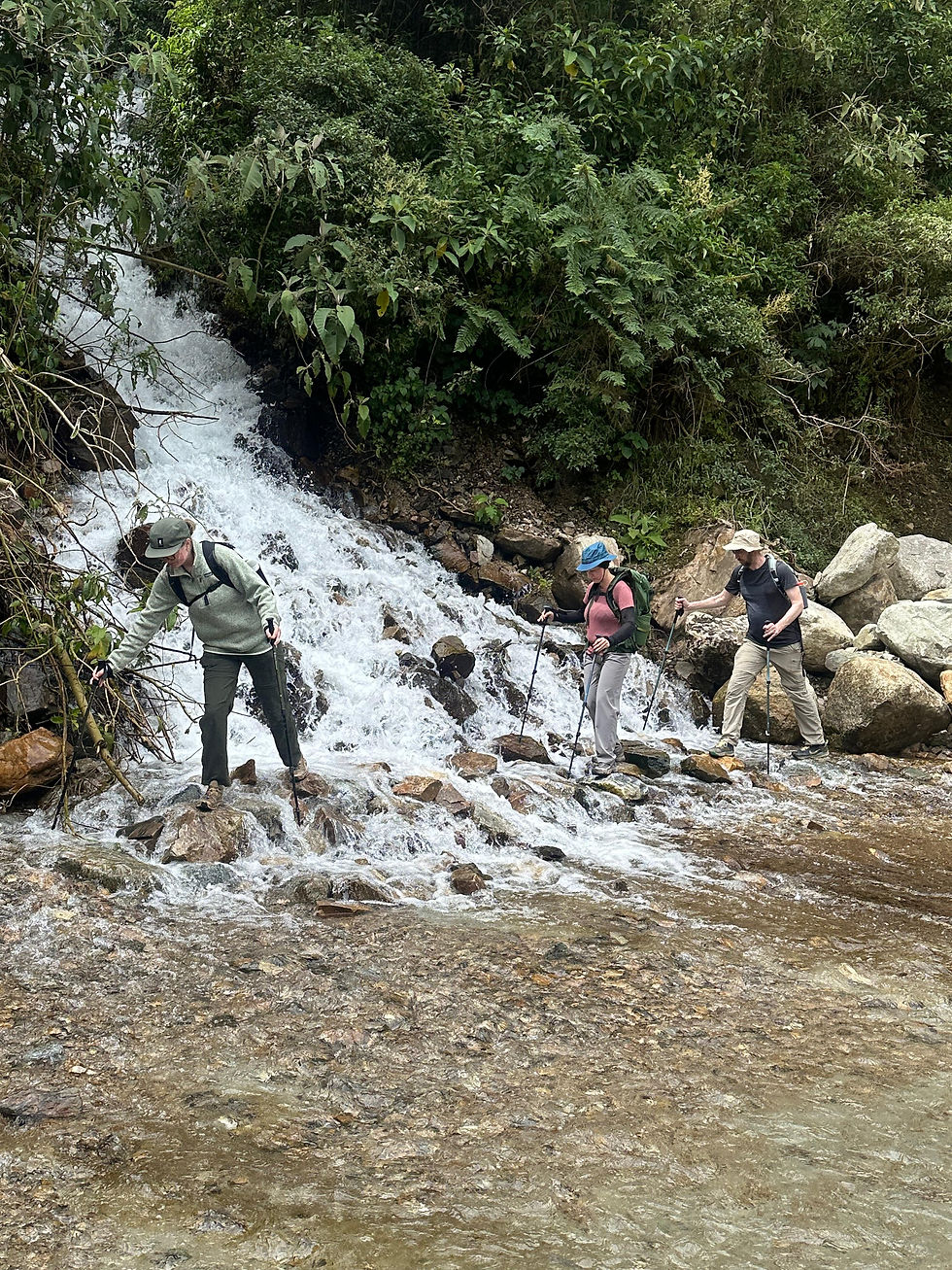
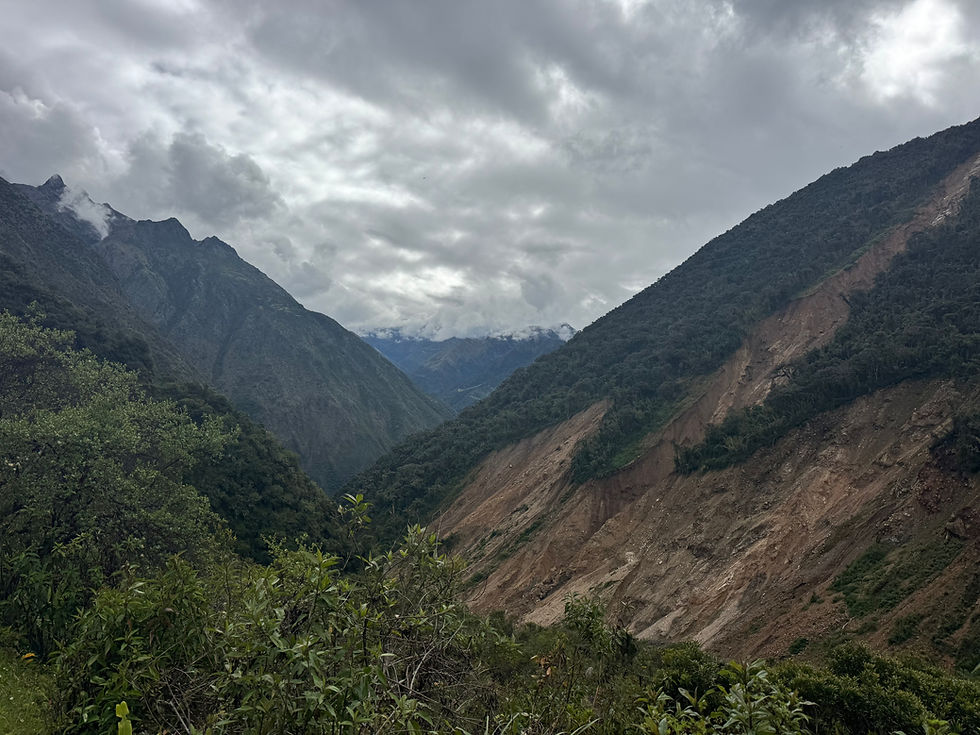
The path we normally would have taken on this trek was across the valley. We could see it at points and its green bridges over mountain rivers. Guido pointed out the landslide that had buried the path just the week before. It was substantial.

Landslides were a recurring theme on the trip. We were just at the beginning of the dry season, and apparently every rainy season huge chunks of the mountains regularly slide off. It’s just a normal thing. Every year the Peruvians who live in the mountains have to excavate and remake a handful of roads.

He also pointed out patches of the mountain which were clearly - on a very steep slope - cultivated. They were farming avocados, passion fruits, corn, or potatoes on the side of a mountain. Peruvians are astounding.
We stopped at a small farm where they grow passion fruit and cacao. He showed us the canoe-shaped bean pods, and the beans they produce. They smelled delicious and I tasted one. It tasted like the purest, darkest chocolate you could imagine. Duh.

He also produced two bottles of pisco, the Peruvian spirit made from grapes - similar to grappa. The first had chunks of bark floating in it. The bark was medicinal, he told us, and the pisco was also sweetened with bee pollen. He offered us some, and several people raised their hands. He poured us substantial shots in these little horns, and instructed us to pour out a little for Pachamama before drinking them.
Pachamama is the Incan deity still revered by Andean people. Often translated as “Mother Earth”, she is more than that; she is the omnipresent deity that is the source and balancer of the four Quechua principles of Water, Earth, Sun, and Moon.

The shot was herbal, earthy and sweet. Then he raised the second bottle of pisco. This one was medicinal as well. There was a coiled snake sitting in the bottom of it, soaking in the liquor.
I was the only one who raised my hand this time. I poured a bit out for Pachamama and drank it in one go. It tasted stronger without the bee pollen to balance the liquor. As far as the snake, I’m not really sure. It was fine. All I can say is it had a vague “meaty” flavor to it. Maybe I could describe it better if I’d had plain pisco to compare it to.
Our next stop after some more walking was a coffee plantation. Guido took us through the whole process of hand-making coffee.

The cherries are put through a hand-cranked contraption that pulls the fruit off. They then remove the endocarp and let the beans dry in the sun for weeks. The parchment is then removed exposing the seed, or what we would call the coffee bean.

We put a handful of these dried seeds into a clay pot that rested over an open flame. Each of us took a turn stirring the beans, roasting them to an even light brown - or a half-roast as it’s called. We then ran these through a small hand grinder, and mixed them with boiling water.

A few minutes later we each had a small taste of the coffee we’d just made. It was good and fresh and unlike any coffee I’d had before. I’m not a coffee connoisseur by any stretch, but it had the sour acidity I’ve tasted at places like Blue Bottle where the snootiest of coffee snobs go. I don’t particularly like that flavor, but what does a peasant like me know?

After a full and flavorful day, we caught a shuttle van to get us the last stretch around the landslide to the Jungle Domes. These also had expansive glass walls, but they were tucked into the jungle rather than on the side of a mountain. Thankfully we were still high enough that there were barely any mosquitos.

DAY 4
It was clear from the start of the day that the physical challenge part of the trip was over. We were dropped off by a shuttle van and clambered a half mile along a frothing river over the remnants of a massive landslide to arrive at the Banos Termales de Cocalmayo - the hot springs.

We got there first thing in the morning, so for the first hour we had it practically to ourselves. Soaking in hot water, stretching my tired muscles was divine. We were now just below 6,000 feet, so the Andes towered above us as tall as gods. I definitely wasn’t in KANSAS anymore (thank god).

Two hours in the pools and a cheeky shot of Inca tequila later, we were back in the van. As we drove we saw regular markings on the buildings we passed. We’d been seeing these everywhere. One in particular was really prevalent - a blue “A” in a red circle. We inquired about these and Guido replied that they were in support of political campaigns.
The election was the following day. He went on to explain that in Peru voting is mandatory, and citizens are subject to fines if they don't. Furthermore, alcohol isn’t served to Peruvians on election day.

Our next stop was Hidroelectrica, a massive powerplant at the foot of Machu Picchu, on the backside of the mountain from the ruins. Hydroelectric power provides between 55 and 75% of Peru’s electricity each year, depending on rainfall. A small collection of homes and shops lined both sides of a set of train tracks.
This train, Guido told us, used to run all the way to Cusco. It took 65 years to construct, starting in 1917. Then in 1997 a massive landslide wiped it out. A vote was held, and Peruvians opted for a road rather than repairing the train line.

We ate lunch on the third floor of a building that appeared to be a family’s home and restaurant. The food, like every meal we ate, was fantastic. The stairs leading up listed so severely I didn’t dare let go of the railing as I ascended.
While we waited for the food I was expertly hustled by the eight year old girl I assume lived there. She picked me out as the mark of the group immediately. She walked over and placed a bottle of Inca Kola in front of me. In my remedial Spanish I asked if it was for me to have. “No, esta la venta” she replied. How much? “Cuatro soles” - about $1.40.
Fine, I relented, I’d buy her soda. I gave her a 10 sole note and she rushed off to get my change. Inca Kola, the main Peruvian soda (owned by Coca-Cola of course), tastes nothing like cola in the US. It’s bright yellow and tastes like the bubble gum flavored toothpaste they use at the dentist when you’re a kid.

“Olvido que solo tengo tres soles”. She returned with a tap on her forehead and an Oscar-worthy expression that said “gosh, I’m so forgetful”. She handed me three soles and scooted away before I had a chance to object. The soda had cost me $2.45, was I really going to raise a fuss? No big deal for an American, but a tidy little score for a Peruvian kid. I didn’t begrudge her one tiny bit. Well played young lady, well played.
After lunch we boarded the train which had large skylights that offered views of the mountains above us. Our ride started with four back and forth runs as we rode up a short switchback. I’d never seen a train switchback before.

Thirty minutes later we pulled into Aguas Calientes, a small town perched on the foothills of a mountain overlooking a river. It has only a few thousand residents and is a tourist hub as the last stop before Machu Picchu. You can only get to it by train or by walking, so the few roads carried only little utility vehicles and the Machu Picchu coach buses.

Guido checked us into our hotel, which must have been the nicest one in town. The showers in the rooms had scalding water and wonderful high pressure so we all steam blasted ourselves clean. Honestly, I tried to figure out how they were able to pamper us so completely for the relatively modest price we paid for the tour, but the math just wasn’t mathing. We were so spoiled.

Larissa, Jamien, and I had a pre-dinner drink overlooking the Plaza Pueblo Machu Picchu, where another impressive statue of Pachacuti stands. Similar statues are all around Peru, usually accompanied by a condor, snake, and puma, powerful symbols to the Andean people.

The puma represents Kay Pacha, the earthly living world. Remarkably, the original city of Cusco was laid out in the shape of a puma with Sacsayhuamán as the head.

The condor represents Hanan Pacha, the heavenly realm. It was believed to be the messenger between the living and the gods. The snake, represents the underworld Uku Pacha, or the afterlife.
If I remember what Guido told us correctly, when everyone dies and leaves the earthly realm, they move to the underworld. From there, when they have learned what they need, they are carried to the heavenly realm by the condor before they are reborn again into the earthly realm.

After dinner most everyone went to bed. Jamien and I explored a little.

The city is laid out of the side of a hill with a river running downhill through the middle of it. Several footbridges cross the river at intervals. One of these was adorned with padlocks. Cool aesthetic, but I couldn’t find any information about their significance or meaning.

We ended up at a little spot on a steep narrow street called Cuy Chef which had a couple of outside tables and large Pilsens. Then we called it a night.

DAY 5 - MACHU PICCHU
First thing in the morning we were bustled out of our hotel and into a coach bus packed full with other visitors. The bus proceeded up the mountain on five and a half miles worth of switchback at speeds that felt wildly reckless. The driver expertly navigated hairpin turn after hairpin turn and passed other buses on their way down with inches to spare. Sweaty and exhausted visitors who were climbing the 1,600 stairs rather than taking the bus miraculously got out of the way just in time. The driver didn’t slow once.

I am not a squeamish person but I had to stop looking out the window. Parents, raise your children with the quiet confidence of a Peruvian bus driver and they will go far.
To manage traffic, Machu Picchu tickets are limited and sold for specific time slots. Ours were on the very early side so when we stepped through the stone archway that led out to the viewing platforms we had the place nearly to ourselves.

My breath caught in my throat and emotion welled in my chest. We’ve all seen the pictures for decades, and that iconic view is the first thing you see. But what slapped me in the face was the scale. Nothing can prepare you for it, nothing. Pictures just can't convey it.
The remains of Inca city stretched out beneath me impossibly far. Towering verdant mountains stretched as far as the eye could see - so steep and close I felt like I could almost reach out and touch them. It seemed like I could look off the edge and see all the way down into the center of the world.

Being present there also touches your soul in some intangible way. The place is special. I could feel Pachamama’s presence. It’s no wonder it’s one of the Wonders of the World.
Having done this countless times, Guido positioned and repositioned us in spots for the best pictures. Separately, small groups, the whole group, 20 minutes of pictures.

As he did this, the sun crested the mountains to our right, casting its morning glow on the side of the mountain behind the city. Absolutely iconic. Ten minutes later the sun went behind some clouds. We were there at the perfect time.

Guido then sat us in a corner on one of the terraces for our first lesson. As he recounted the history of the city and its importance to Incan civilization, the clouds rose up from the valley behind him.

By the time he had finished, wispy clouds floated at eye level, some obscuring the mountain.

Guido toured us through the whole site over the next four hours. I can never do justice to everything he taught us. There are hundreds of books entirely dedicated to the history Machu Picchu. But here are a few of the fascinating tidbits that really stuck with me.
The mountain you see behind it in the classic view isn’t actually Machu Picchu. “Machu Picchu” means “Big Mountain”, and it’s the mountain the city is perched on. The peak of Machu Picchu actually looms up behind you. The Inca Trail snakes over the top of it, arriving at its terminus.

The mountain you see in the pictures is “Huayna Picchu” or “Little Mountain”. If you look closely, you can see that the top of it is terraced and has some buildings. You can get separate tickets to take the stairs up to it, which takes about 45 minutes.
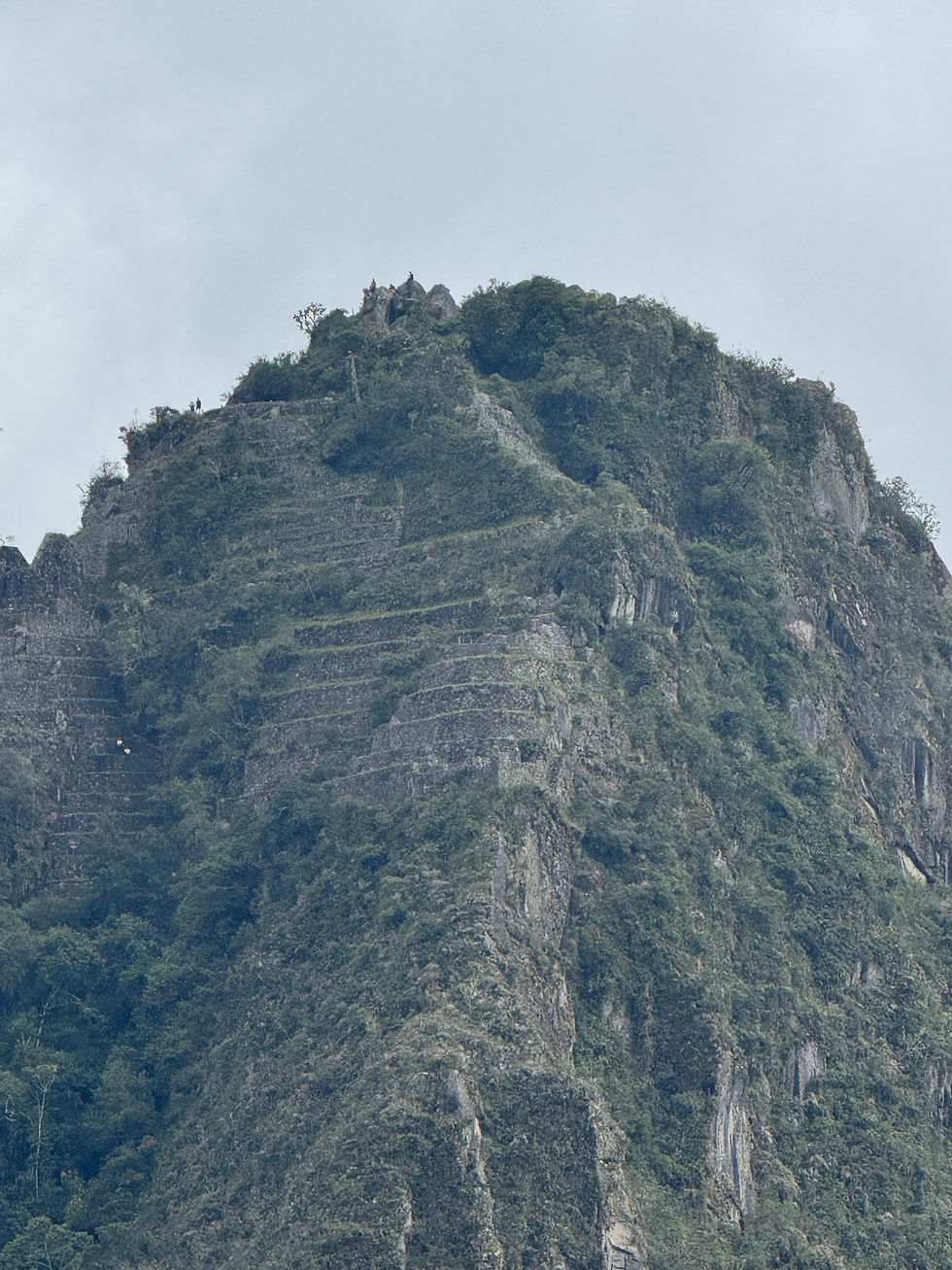
Despite conquering the Inca Civilization in the 1500’s, the Spanish never found Machu Picchu, which accounts for how intact it is. It was strategically remote and difficult to reach. The first gringo to lay eyes on it was Hiram Bingham in 1911. “Discovered” isn’t correct because people lived there for centuries and he was guided to it by local farmers while searching for the mythical El Dorado, the Lost City of Gold.

When he found it, the city had been reclaimed by the jungle, but there were a couple of farming families living there. Subsequent expeditions began the process of excavating it, which is still not complete. If you look down the side of the mountain, you can see terraces and buildings peeking out from the foliage beneath the area that’s been cleared.

Bingham later served as the Governor of Connecticut for a single day, the shortest term in history. He had also been elected to the Senate in the same election cycle and chose that job instead.

No surprise, the stonework is exceptional, though different from Sacsayhuamán. The main quarry for the stones is right next to the city complex. The stones that make up the walls are smaller, but still fit exceptionally well. In many places huge stones were incorporated into the walls rather than being shaped or moved. This gives the feeling of the city growing up from the land, an extension of it rather than a construction on it.

The most exceptional example of this is the Temple of the Condor, where two massive natural outcroppings sweep together in a shape resembling a bird inflight.

Something else that blew my mind was the way they dealt with earthquakes. It’s the sixteenth century, your city is on top of a mountain in a heavily seismic area - how do you construct stone walls that will stand for hundreds of years? The walls have occasional holes in the stonework and within them are cylindrical stones. During an earthquake, these stones are able to roll back and forth very slightly while bearing the weight of the walls, giving the structures enough flex so that they don’t crack and crumble. The engineering is mind boggling.

There is a vast series of terraces that were constructed to farm crops for the large population who lived there full time or short term. People would travel incredibly long distances along the Inca Trail to spend a few months at Machu Picchu. This was a holy pilgrimage, but they would also contribute during their time to construction, farming, or whatever their skills were. This was, in a way, a barter form of paying taxes.

Speaking of bartering, the Incas had no system of currency. They had gold trinkets and other valuables but no money. Furthermore, they had no written language. What we know about the Incan civilization is from a combination of oral history, archeology, and written accounts of the Spanish conquistadors.

Apologies to Guido if I got any of the details wrong. It’s impossible to encapsulate everything that we learned over the course of four hours in this post (which is already long enough). Suffice it to say, the experience was mind blowing in every way and Guido was a phenomenal teacher.
DAY 5 - CUSCO
After another spine-tingling bus ride back down to Aguas Calientes, Guido gave us an hour to explore while he ran off to vote. We had lunch together at a restaurant, and were presented certificates and medals for completing the trek. We then boarded the train back to Cusco.

We walked up the train platform toward our car, which was near the front. It turned out we got first class tickets for the ride back. Again, the level of service and comfort compared to what the trip cost was astounding. A four-piece band played on the platform while someone dressed as a bizarre technicolor Mardi Gras cat danced and welcomed us. I guess this creature is the PeruRail mascot?

Thirty minutes into the ride, an announcement invited us up to the front, and music started. Initially I stayed in my seat, but curiosity got the better of me. The next car up was the bar car (not serving alcohol on election day), which hosted the band from the platform, the day-glow cat, and an open space that served as a dance floor.
The next car up with the Vistadome Observatory. The car was all glass with seating in the middle for people who wanted to admire the gorgeous scenery as it passed by.

Finally at the front of the train was a small balcony platform. I found Larissa there. We leaned out of the train and enjoyed the wind in our faces. I mugged for the camera and did my best Anthony Bourdain impression. I have .000001% of his cool.
I found my way back to my seat for the next twenty minutes. Then another announcement came over the speakers. Then banging techno music started playing. It was time for the fashion show. Wait, what?
The two train attendants who had been serving snacks switched into diva mode and strutted up and down the aisle wearing different scarves, capes, and cardigans made of alpaca wool (which the train conveniently sold). And they didn’t just go through the motions - they got into it. I got the sense this was their favorite part of the job.
I was riding a train through the Peruvian Andes with a live band, an acid trip bipedal feline, and a live runway fashion show. I honestly felt like I’d had a stroke. Best. Train. Ride. Ever.

The end of the line was the Sacred Valley, where Guido picked us up for a two-hour shuttle van ride back to our hotels. Frequently during the drive, we had to slalom around rocks the size of Volkswagen Beetles which were strewn across the road from recent landslides. These were not dirt back roads, they were paved, well trafficked roads.
One of my lasting impressions of Peru is the frequency of, and the matter-of-fact nature of how they deal with, landslides. It's erosion in realtime. It makes sense when you look at how steep and lush the Andes are. Still, their resilience to live with them as a fact of life is impressive. Peruvians are astounding.

Larissa, Jamien, and I grabbed dinner at Nero across the street from our hotel, a bustling locals spot we had discovered before the trek. They had incredible chicken broasters (Peruvian fried chicken) and large beers. We unwound after a very full five days and watched the election results roll in. There were 35 candidates for President! We felt a little bad being the only table of gringos in the place and the only ones able to drink - but not bad enough to let it stop us.
WRAP UP
I wouldn’t trade this wild experience for the world. Despite being nervous about it, this was one of the most rewarding things I have ever done. That said, I am not going to suddenly start chasing these types of physical challenges. I am content for this to be my pinnacle and leave it at that. To commemorate the trip, I cajoled (bullied?) Larissa and Jamien into getting matching tattoos with me - a first for both of them.
The design is an outline of Machu Picchu on a heartbeat line since our hearts wanted to explode on the hike. I got mine on my calf since that muscle handled most of the work.

If anyone is young, adventurous, fit and/or mildly masochistic, I would say absolutely do this. I cannot recommend Salkantay Trekking enough. To say they took care of us doesn’t begin to capture it. Also, if you do, try to schedule it on a week when Guido is doing it - he was the perfect guide. Apart from being a font of knowledge on the Incan Civilization, his experience growing up there in the mountains provided a personal touch that made it really special. After two days off he left on a 7-day Inca Trail trek - crazy.

We made friends with four incredible young women with whom, on paper, we had nothing in common. I can’t imagine any reason we would have ever crossed paths and had a conversation in regular life, but by the end we were all thick as thieves.

The trek was way cushier than I had expected, and every bit the challenge. But we did it - and on deadline, a week before Larissa turned "milestone birthday". Now Kristina is getting married in just a few weeks! So raise a glass for both of them, and don’t forget to pour a little out for Pachamama.
Yes, and…
Matt


Comments