Physical State of Matt #31: NORTH DAKOTA
Updated: Jan 11
I think it’s safe to say that North Dakota has the reputation of being the most boring and drab state in the union, so much so that the state’s tourism board has wittily embraced it. But I’m getting ahead of myself.

I pulled off of the road at the border between North and South Dakota. Surrounded on both sides by sweeping green pastures, my only company was the occasional speeding motorist and a scrum of black cows on the horizon.
I may have allegedly left another pair of stickers behind on the welcome signs. I gleefully decided to take North Dakota’s command to heart - "Be Legendary". Yes, and…

BOWMAN
My destination for the evening was Bowman, a sad little blip on the map without much to offer other than it was about as far from Custer State Park as I felt like driving that day.
As I checked into my serviceable hotel, I was encouraged to see the young woman behind the counter reading George Orwell’s 1984 and Maya Angelou’s I Know Why the Caged Bird Sings - not what I would have expected in a rural town in our third reddest state, behind only Wyoming and West Virginia.

As she made my key, another guest sidled up to the counter. He’d locked himself out of his room - again. We got to chatting and he invited me to have dinner with him and his buddies in the parking lot, where they were grilling on the flatbed of his pickup.
By the time I dropped my bags, freshened up, and made it outside, the only thing they had left to eat, they sheepishly admitted, was franks and beans.
After my long drive, I was grateful for them. This rag tag four-man crew from several neighboring states was there to repair one of those giant industrial windmills. It sounded like really challenging work, especially because it took them away from their families for weeks or sometimes months at a time.

They excitedly showed me a video they’d shot the day before of an epic tornado touching down. They’d been surrounded, they told me, by several teams of storm chasers. When the professionals all simultaneously cut and ran to their vehicles, kicking up dirt as their tricked-out trucks peeled away, these guys figured they should also hightail it out of there. What followed, they described, was a 110 mph retreat that would have made Jan de Bont proud.
The Be Legendary part of me was wished I had come to North Dakota a day sooner. The rest of me was relieved I had not. In any case, I was so enthralled with their story that I completely forgot to ask if they would share their video with me. I’m still kicking myself.
The following morning, a stiff wind and roiling clouds had replaced the previous day’s dazzling sunlight. As I passed out of Bowman, an odd assortment of metal structures appeared along the left side of the road. I chucked a uey for a closer look.
There was a train trestle, sans track, looking incongruous in the grass without so much as a creek flowing beneath it. There was a towering searchlight. There was a small plane mounted on a pole, gently spinning in the wind - the largest and coolest weather vane I’ve ever seen.
But what captured my imagination most was the mannequin cowboy riding a missile mounted on a rusted old-timey fire truck. There is scant information online about this installation. Near as I can tell it was erected to commemorate Bowman’s role during the Cold War as a missile site.


The sculpture unmistakably evoked the final scene of Stanley Kubrick’s masterpiece Dr. Strangelove in which Major Kong rides a nuke out of the belly of a bomber, hooting and waving his cowboy hat the whole way down. I wondered if the creator had ever seen Dr. Strangelove. I wondered if they had realized it was a deeply anti-war satire. Given the work’s patriotic earnestness, I suspected not.
WHITE BUTTE
20 minutes north of Bowman I took a detour off of I-85, following a sign to the state’s highest point of elevation - White Butt (teehee, ahem), Butte. Given how flat I’d found North Dakota so far, I thought, this should be good. I expected a molehill in a field somewhere. I wasn’t far off.
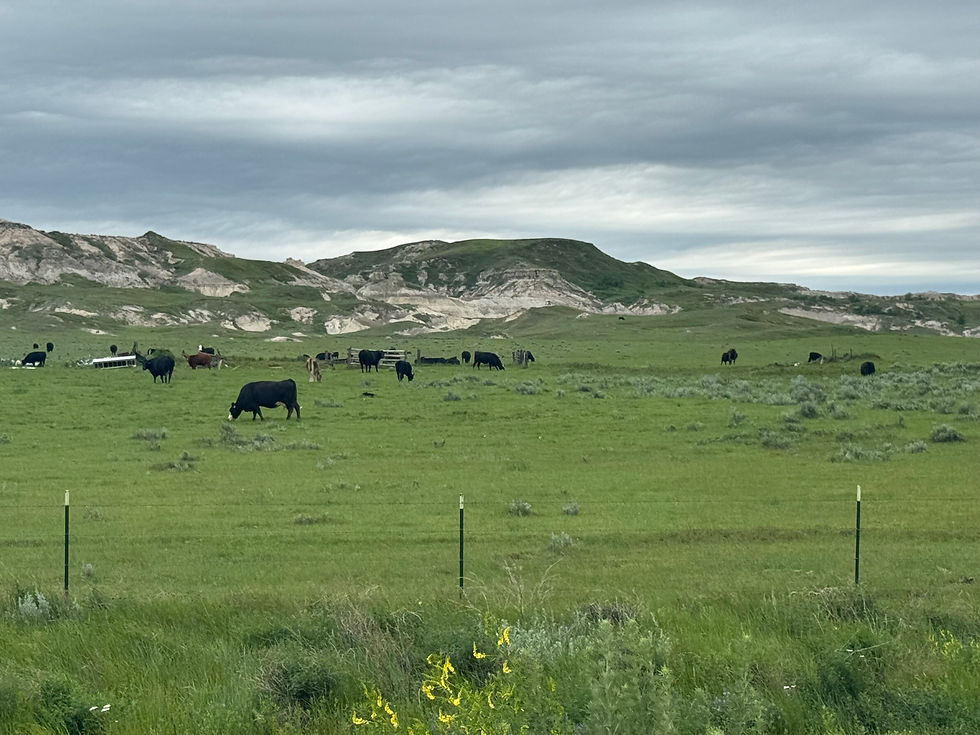
White Butte is an unimpressive mound of rock in a sea of grass. Taken on its own, one could say it is pretty. But after hiking the jagged majesty of the Tetons and driving through the craggy beauty of the Black Hills just the day before, it was bush league. To be fair though, North Dakota had promised to be legendary, not topographically interesting.

I left the main road, following my AllTrails app to the trailhead of the path up to White Butte’s summit. The app led me to nowhere, so instead I improvised my way along dirt roads, trying to stay pointed at the butte.
I never did find the trail, but I discovered a spectacular ramshackle house, an asset North Dakota seemed to have in abundance. I suppose it’s cheaper when a building falls into irredeemable disrepair to let the harsh winters destroy it in slow motion rather than tear it down.

Although the building made North Dakota’s high point appear that much sadder, it was also picturesque in a stark sort of way. I have always been fascinated by abandoned buildings. There is a thrilling poetry in exploring them - an eerie melange of archeology, voyeurism, and danger. I responsibly stopped trespassing when I hit my twenties, but the urge remains.

THEODORE ROOSEVELT NATIONAL PARK
At Belfield, I turned west on I-95 toward Medora and saw my first of many glorious yellow fields. Although I was unfortunately a month too early to witness the expanses of blooming sunflowers for which North Dakota is known, I did hit the flowering season for rapeseed.

Rapeseed was one of the earliest plants cultivated by humans as many as 10,000 years ago. Early uses of the oil produced from its seeds included fuel for lamps and, in more recent history, lubricating oil for machines during the Industrial Revolution.

In the 1970s Canadian scientists engineered a strain that brought the erucic acid content of the seeds down to a low enough level so that rapeseed oil was safe for human consumption and rebranded the unfortunately named plant canola. Canola is now the third largest source of vegetable oil in the world after soy and palm.

Medora is yet another small tourism-focused “Old West” town. What makes it notable is its location at the main entrance to the Theodore Roosevelt National Park - the North Dakota Badlands.

Theodore Roosevelt first visited the area to hunt Bison in 1883. The 24-year-old was enamored of the rugged landscape. On Valentine’s Day of the following year his mother died of typhoid fever and his wife died from kidney disease a few hours later. His wife had given birth to their daughter just two days prior. Fucking brutal.

Roosevelt retreated to the badlands to mourn and established Elkhorn Ranch. He found the strenuous work of frontier life cathartic and the wide open spaces restorative. During his many years there he developed a deep love of the land and its wildlife. This love carried over into his presidency and ultimately his legacy as the “conservation president” having established five national parks and 18 national monuments while in office.

Although the sweeping views didn't quite measure up to those of the badlands in the other Dakota, they were stunning nonetheless. They were also more lush - at least at this time of the year.

The wind was driving a fine drizzle sideways, which made being outside uncomfortable, so I opted for the scenic loop. The flat areas just inside the park’s entrance were overrun with prairie dogs, the clovered grass polka dotted with their burrows. The absurd rodents ran around like rambunctious children. Their silly little tails would wag furiously for a second before they pounced on one another.
Wild horses grazed casually along the side of the road.

Winding up into the hills, I drove past a sign informing visitors that if they see smoke not to call the park office in a panic, it’s most likely just an underground coal fire - wait, WHAT?!
Coal-seam fires, a phenomenon I had no idea existed, are usually started by lightning or wildfires and progress in a slow, smoldering burn, feeding themselves with oxygen through holes and fissures in the ground, the heat of the fire creating convection currents. The park sits atop layers of lignite, a soft and highly flammable coal made from the compressed peat of the region's prehistoric swamps.

The Coal Vein Trail is a rugged .8 mile hike that was created after a 12-foot thick coal vein caught fire in 1951 and burned FOR 26 YEARS! The rock and earth that had been resting atop the vein collapsed as the coal beneath burned out.

A large portion of the scenic loop was unfortunately closed for maintenance, so I turned around when I hit the barricade and left the way I’d come in.
ENCHANTED HIGHWAY
My plan was to spend the next several days in Bismarck, which was halfway across the state, so I buckled in for a long, mind numbing drive - or so I thought.
Less than an hour from the park, I exited the highway to investigate a large, unusual sculpture I had spotted atop a hill. I pulled Pierogi into a dirt parking area and gawked at the imposing 110 foot tall creation. It was striking, the silhouettes of ten flying geese floating in front of a sunburst shaped like an eye. What it was doing way the hell out there was a mystery to me.

A dilapidated notice board on the edge of the parking lot promised they would “treat me like royalty” at a place called the Enchanted Castle Hotel and Restaurant in Regent, a mere 32 miles south on a road called the Enchanted Highway. What the hell, I said to myself, I’m in. What’s another 65 miles?

I set out, unsure of what made this highway enchanted, but looking forward to seeing more of the countryside from a small road away from the highway. I got my answer a few miles later.
Another 75-foot-tall metal sculpture appeared on the right, a similar dirt parking area beside it. This one depicted two deer, a stag leaping over a fence and a doe leaning forward, about to follow him.

Behind the deer was a lonely labyrinth made from sections of four-foot metal fencing cut with geometric patterns. "Maze of Enchantment", the sign read, "Built For Your Enjoyment". The sign was in that 1980s “Vote For Pedro” font. I posted a picture of it on Instagram, sardonically captioning it “North Dakota amusement park”.

Five more massive metal sculptures followed along my route to Regent, each one more whimsical and befuddling than the last.

There were giant grasshoppers and blades of wheat alongside a seatless baby grasshopper mounted on a spring. The only thing missing was a sign asking parents to ensure their children are up on their tetanus shots before riding it.

There was an underwater scene with fish swimming between tendrils of seaweed, one breaching the surface for a dragonfly. A tiny metal man floated in a tiny metal boat, fishing with a rod so small those aquatic behemoths could have used it as a toothpick.

Next was a family of pheasants, the babies pecking the ground for food.

Then a stagecoach and Teddy Roosevelt waving from the back of a rearing stallion.

And finally there was a tin family. Dad the farmer, mom fresh from picking flowers, and Junior licking a lollipop the size of a wagon wheel.

After the tin family, I arrived in Regent, a sleepy hamlet, population 164. The Enchanted Castle Hotel and Restaurant turned out to be in a converted building that had been, until a couple of decades ago, Regent High School.
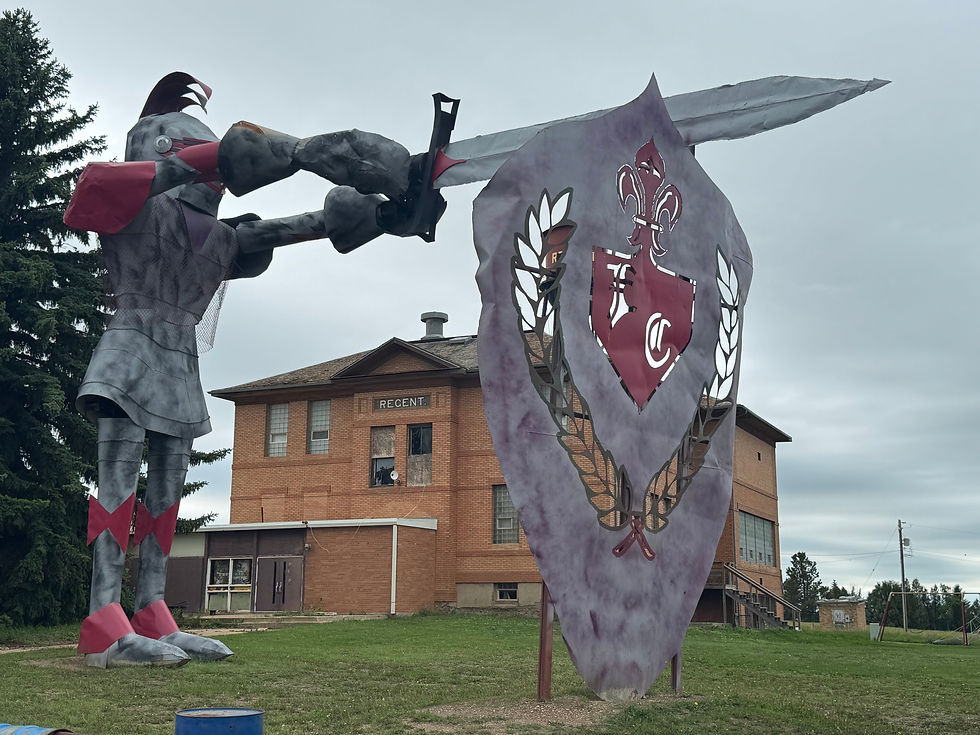
On its lawn was a 40-foot knight squaring off against what I could only imagine was a lifesize dragon. Sadly the restaurant was dark so my royal treatment would have to wait. In fact, the only sign of life in town was a cop sitting in his cruiser, eyeing me suspiciously.

I wandered over to the Enchanted Highway Gift Shop, outside of which was one last metal sculpture - the cross section of a house. There was a prominent green button above a sign that read "To Watch Wirly-Gigs Turn on Here". Pressing the button brought screeching gears to life that animated the little family inside the house.
The inside of the gift shop was warm and inviting, and as well stocked as any I’d seen at the many national parks I’d visited. The woman behind the counter welcomed me in, gushed about the Enchanted Highway and shared some of its history with me.
In 1989, Regent native Gary Greff left his job as a teacher in Montana and returned to his hometown to care for his aging parents. He found the small town that he was so fond of withering. Gary took it upon himself to revive his community. His first idea of creating a fresh chopped onion product which could support a local factory never came to fruition, but he didn’t quit there.

He felt that if he could create a compelling enough attraction, he could convince tourists to make the 32 mile drive from the highway to Regent, bringing much needed money into the community. Despite having no experience in welding, he set out to build not just big metal sculptures, but the biggest.
The woman in the gift shop proudly pointed to the framed certificate on the wall. Geese in Flight, the first sculpture that had enticed me off the highway, was recognized by the Guinness Book of World Records as the largest scrap metal sculpture in the world.

Despite the lack of traffic on this inhospitable Sunday afternoon, she assured me his gambit had paid off. Tourism dollars had kept local businesses alive. Beaming with pride, she told me that a second gas station had just opened in town. I supposed, as evidenced by my sample size of one, it must have worked. Between my purchases at the gift shop and fill-up at the new Cenex station, I had spent about $75 in Regent. A drop in the bucket to be sure, but a bucket that wouldn’t have otherwise existed.

I can’t claim to have been enchanted by the Enchanted Highway, but I was certainly charmed. It had overcome my dismissive snarkiness. Sure, a couple of the sculptures like the Tin Family have an amateurish quality to them, but in Gary’s defense that was the first one he built and he had just learned how to weld.
Some of the pieces, notably Geese in Flight, the grasshoppers, and the fish, are truly remarkable. The Enchanted Highway was perhaps the most memorable roadside attraction I had seen so far. It was also an inspiring story of one man who, with great effort and presumably at great expense, rescued his neglected community purely out of love for it.

His sculptures may never grace the lawn of the Smithsonian, but they got this weary traveler to take a 3 hour detour to a town he wouldn’t have otherwise known existed. Good for Gary Greff, and good for Regent.
BISMARCK
As I parked on the street in front of my Airbnb, I realized that I hadn’t booked myself in Bismarck proper, but the small adjoining city of Mandan across the Missouri River. The place was eclectic but comfortable. Creeping vines of several pothos plants had been guided to trace the crown molding on all of the dining room walls, giving it a funky greenhouse vibe. My only concern was that the bathroom door had a clearance of less than six feet. I’d have to be careful not to concuss myself taking a sleepy pee.
Downtown Bismarck was a ghost town. I ate a halfway decent shepherd's pie and Guinness at the Blarney Stone. The interior of this “Authentic Irish Pub” was identical to all of the other Irish knock-off watering holes of which this country has thousands - nothing like an actual Irish pub but familiar. I’ve been to so many of these that they are now comforting - like a Temu “homespun” quilt.

The local barcade, CraftCade, was actually quite cool. I went there twice during my time in Bismarck. The food was surprisingly good. They had self-serve beer taps where I could scan my card, sample anything, and pay only for the ounces I poured. And the games were free, except for pinball and blackjack.

Blackjack? I hear you asking. In a regular bar? I had the same question. When I was younger, I was under the impression that gambling in the US was only legal in Vegas, Atlantic City, and on Indian Reservations. True, regulations have loosened in the last few decades, but I have been shocked at how much gambling, particularly slot machines, has proliferated in the US. Today, gambling is only completely illegal in four states: Utah, South Carolina, Georgia, and Hawaii. But I had never - never - seen a table game in a bar.

North Dakota has “Charitable Gaming” laws which permit this. The games in bars must be operated by, and all proceeds must go to, a charitable organization, which struck me as a great idea - use vice to fund good deeds without funneling the cash through government budgets like the lottery does. The table minimum was $3 per hand. No punter on the Vegas Strip has sniffed a $3 minimum since the Rat Pack was raising hell at The Sands. I lost some, I won it back, then I quit when I was only down the amount I’d given the dealer as tips.
The dealer recommended that if I wanted to play roulette, they had it over at Pub 21. I like blackjack, but I also enjoy a few spins of the wheel - the five seconds of exhilarating agony while the ball bounces around looking for its number, the 35-1 payouts on the rare occasion your number does hit. It’s a fun, mindless game punctuated with big shots of adrenaline.
When I walked into Pub 21, I was bemused to find not a roulette table, but its local redneck cousin - Pig Wheel. The wheel was three feet in diameter and mounted to the wall. A pointer at the top skipped between pegs along the edge of the wheel mounted between each number. Instead of 36 numbers plus the green 0 and 00 spots, this had 40 numbers plus five pigs with goofy names. At a payout of 40-1, the odds favored the house a few percentage points more than roulette, but I pulled up a beer and had a go anyway.
The wheel had an infuriatingly long spin that sounded like a kid with a playing card in their spokes coasting down the longest hill in town. Every time I got excited that my number was coming up and I thought the wheel was about to stop, it would sail right on past.

I got close a few times, but spin after spin I didn’t hit. By the end of my second beer I was down $200. With frustrating frequency, my number ended up close to the bottom, as far from the pointer as it could get. I started tracking where on the wheel the winning numbers resided and spotted a pattern. The croupigier alternated which way he spun the wheel. Clockwise spin results were pretty random, but counterclockwise spins landed in the same sector of the wheel 3 out of 4 times. The wheel must have been very slightly out of balance.

I started betting with the pattern, and by the end of beer three I was up $400. It then occurred to me that, by winning, I was essentially taking money out of the hands of a charity. I stopped playing with a visceral understanding that although charitable gambling lets you still feel good if you lose, it takes the fun out of winning.
Bismarck offered few options for interesting hikes or entertainment, so I spent much of my time at the Airbnb. I wrote one of my most challenging and personal posts yet - DEPRESSED - and I painted the most complex miniature I’ve tackled in a while. It took me around 30 hours.
Until COVID I didn’t really have any hobbies as an adult, unless you count watching movies and playing video games. It wasn’t the working from home that drove me to find one - I’d been doing that for years already. It was because I hated my job. I couldn’t be successful no matter how much effort I put in. Companies were spooked and no one was buying. I just started phoning it in after a while. I saw no sense in looking for another job - no one was hiring either.
I rediscovered my childhood joy of building plastic models which, after a couple of kits, morphed into painting miniatures. I don’t have particularly steady hands or keen eyesight, but I’ve managed to get pretty decent and it is one of the best tools I have to manage stress.

When painting the edge of the tiniest corner of plastic you can imagine, you have to be as focused as possible - even to control your breathing. This kind of precision puts me into a flow state. Focusing on the micro helps me forget about the macro for a while.
To give you a better sense of scale, here is one component of the mini I painted - a shield with human skin stretched over it, presumably made by the Buffalo Bill of orcs.
On my last day in Bismarck I took a cruise up the Missouri River on the Lewis & Clark Riverboat.

Several bird-themed sculptures graced the river’s shore, the most interesting one a Native American-inspired piece featuring the heads and claws of four thunderbirds facing each of the cardinal points of the compass.

Underneath the nearby bridge, swarms of swallows swooped in and out of their mud nests with the manic frenzy of a school dance after the punch was spiked with meth.
I had been expecting some sort of narration on the cruise explaining the history of the river’s role in the area, its exploration, or some such, but no. The boat just cruised slowly up the river, country music playing from its tinny speakers. When we got far enough north to see the flare stacks of the Mandan Oil Refinery, we turned around and headed back.

FARGO
Fargo lies on the eastern edge of the state, along the Red River of the North, which separates North Dakota from Minnesota. The area is actually called Fargo-Moorhead since the Minnesota city right across the river from Fargo creates one continuous urban area. The Red River is one of the minority of rivers in the US that flows south to north. The elevation change leads the river to empty into Winnipeg Lake and eventually Hudson Bay rather than the Gulf of Mexico.

The landscape on the 3-hour drive across the remainder of the state looked much the same as everything else I’d seen east of the national park, but I did find something that has lived rent free in my head since.
I came upon the faded corpse of a wooden structure on the highway's southern berm with a large red-lettered Trump sign on display to passing motorists. Dilapidated buildings, as I’ve noted, are not uncommon in North Dakota, nor are Trump signs in much of the country. On this one however, someone had spray painted “Jesus” over Trump’s name in big black letters.

I pulled off at the next exit, doubled back the 10 miles to the previous exit and returned, pulling to the shoulder to take a picture. Who had painted this? How should it be interpreted? Was it saying Trump is synonymous with Jesus, that Jesus trumps Trump, or something else entirely? The lettering of both names looked equally weathered. Had the person who hung the Trump sign done this or had someone vandalized the sign later? I have pondered this enigma with unsettling frequency since.

Fargo is about as different from Bismarck as you can get. It’s a hip and thriving city with nearly twice the residents.

Although the head tourism office for North Dakota is in the capital - Bismarck - the visitors center in Fargo has made itself a destination by embracing the beloved Coen Brothers film of the same name.
When Joel Coen was asked why they named the film Fargo when almost all of it takes place in Minnesota, he quipped that no one would have gone to see a film titled Brainerd.
In Fargo’s most iconic scene, one of the inept villains disposes of his partner’s corpse by putting it through a wood chipper. Despite the opening credits of Fargo saying it is based on a true story, it’s not. The Coen Brothers added that to the film to make its ridiculous events more plausible to audiences. The wood chipper scene however, was inspired by a the 1986 murder of Helle Crafts in Connecticut.
Initially, the city was disquieted by its association with a film that had such a grisly ending, but they eventually came to see it as an opportunity.
In the early 2000’s, the city tracked down and purchased the wood chipper from the movie, which was owned by one of the film’s crew and was being used to actually chip wood. They now display the machine in the visitors center alongside other ephemera from the film. It’s a photo opp, complete with props of a fake leg and a piece of firewood. Around this same time, North Dakota also started using the tagline “North of Normal” in its tourism campaigns.

Because of the state's reputation for being boring and bleak, many people visiting all 50 states went to North Dakota last. The tourism folks figured out a clever way to embrace this and turn it into a strength and created the Best for Last Club. People who “save the best for last” are given a commemorative t-shirt, certificate, and round of applause. Although I was tempted to lie to get these rare souvenirs, I didn’t.

I ate a late lunch at Space Aliens near the visitors center, a restaurant that had seriously committed to their theme.

On my way out of town, I stopped in downtown Fargo to find a specific mural - one of the 18 they have within a 10-block area. I found it on the wall of an alley behind The Toasted Frog.
One of the kitchen staff, a young woman with colorful hair, was sitting on the stairs having a smoke. I roped her into taking a photo of me jumping in front of the mural, but we couldn’t get our timing right. After a few tries, I had her shoot a video and I screenshot the best frame.

I’ll admit I’ve taken a few snarky cheap shots at North Dakota, but I actually liked the state. Although I can’t help but wonder what my week would have looked like if I’d picked Fargo (the obvious place) as my destination instead, I’m glad I got to see Bismarck.
Yes, much of the state is flatter than the roadkill on I-95, but it’s also beautiful in its own way. The spare landscape frequently draws geometric lines to a vanishing point along the flat horizon, unbroken by trees or buildings. I would happily return to North Dakota, especially to Fargo, though maybe not in January when the average high is 16.

In the early afternoon I departed downtown Fargo and crossed the Main Avenue Bridge into the land of 10,000 lakes.
Yes, and...
Matt


Comments