Physical State of Matt #30: SOUTH DAKOTA
Updated: Dec 29, 2025
Somewhere along the line I lumped North and South Dakota together in my mind. I’d been told repeatedly that North Dakota was flat and boring - miles and miles of nothing. I guess I just mentally conflated the two. South Dakota has the highest ratio of cows to people of any state (3.91), so it didn't seem like a huge leap.
But everyone I spoke to within three states of the Dakotas was quick to correct me. South Dakota they said is pretty remarkable, and not what I pictured. So I went into the state with low expectations but an open mind, ready to be proven wrong.

The first stop on my drive from Nebraska was back in Okoboji, Iowa to visit Steven and Brayden. The night I arrived, we made plans to eat again at Steven’s second home - Maxwell’s in Arnolds Park. An AC/DC cover band was playing the pavilion so we could follow dinner with some music.
It was a summer Sunday and Maxwell’s was packed. It was good reconnecting with some of the same people I'd met my first time through the state. I had finally published my IOWA post two and a half months prior. Steven and everyone I'd met in the community had gone out of their way to share it. Susie even generously linked to the post from the official Arnolds Park email newsletter

Over dinner I was introduced to several people I hadn't met the first time I was there. I was no longer just "Steven's friend", but "Steven's friend - the guy who wrote the thing". It was a new experience meeting people for the first time who already knew me from something I'd written - good, but surreal.
Over dinner, Maxwell's owners presented Steven with a new drink they were planning to put on the menu, an Aperol margarita, and asked for name suggestions. We brainstormed a few, but Steven tapped into the zeitgeist and came up with the one they ended up using - the Pink Pony Margarita.
As dinner was ending a sudden, unexpected downpour shut down the music so we called it a night.

THE DRIVE
The moment I entered South Dakota, I saw my first billboard for Wall Drug. If you've never been to South Dakota, Wall Drug will probably not mean anything to you. It meant nothing to me, but it was probably the number one thing people had mentioned when I asked them about the state.

In 1930 Wall Drug was a tiny pharmacy in the middle of nowhere - Wall, South Dakota. The founder’s wife Dorothy Hustead came up with the idea to advertise free ice water on a large sign to entice people traversing the state during the Dust Bowl to come through their doors. The strategy was a great success and their business boomed.

95 years later there are now 300 official Wall Drug billboards advertising free ice water, 5 cent coffee, homemade pies, and more in South Dakota and a few surrounding states. On my 400 mile trek from Iowa to Wall they became as mind-numbingly omnipresent as the wind sweeping over the plains. I say “official” because beginning in WWII several unofficial “X Miles to Wall Drug” signs have popped up in various cities around the world.

Just over the border from Iowa lies Sioux Falls, which was my first stop. I pulled into the parking lot by the falls overlook and emerged feeling like I had teleported inside a snow globe. The cottonwood trees around the park were shedding their fluffy seeds in staggering quantities, giving everything a slight fairytale surreality.

The falls themselves were only running at a trickle. Although I was tempted to clamber around on the exposed rock as I saw others doing, the entry point was on the other side of the river and I had a lot of driving ahead.

The landscape as I drove west was as I’d anticipated - flat and pretty featureless. A foreboding cloud swirl threatened to storm on me, but thankfully I passed out from underneath it before I was caught.

When the sun emerged the verdant plains dazzled me so much I didn’t mind that they were the only things to look at.

About 70 miles after Sioux Falls I pulled off highway 90 to visit The World’s Only Corn Palace. In 1892 a wooden palace was erected in Mitchell, South Dakota to serve as a gathering place for the community. Its walls were covered with murals made of corn to celebrate the region’s agricultural focus.

The following year the murals were replaced with new designs - this time incorporating symbols of the Freemasons, Grand Army of the Republic, etc. And so it went for 13 years until an even larger structure was erected in 1905, repurposing the lumber from the first one.

The tradition continued, and in 1921 a massive permanent building was erected. This third structure is the one that still stands today although there have been small additions and design flourishes added over the years.

This year’s mural theme was “Wonders of the World”. I parked on Main Street and approached the building on foot. It was hard to imagine that these murals were made entirely out of corn, but I could see that there was a scissor lift parked underneath a giant depiction of the Statue of Liberty, the border of which had not yet been completed. Upon closer inspection, sure enough - corn.
The inside of the palace is a combination theater & sports venue. Past an empty box office and working concession counter, the hall led me around the corner and through a doorway. I emerged into rows of theater seating that overlooked a gymnasium with a stage on the far side under more corn murals. The basketball nets on either side of the court were lifted up to the ceiling and the scoreboard on the ceiling advertised future events. A gift shop on wheels was spread out across the hardwood.

The Corn Palace hosts concerts, basketball games, theater, proms, graduation, festivals, banquets, you name it. Over half a million people visit it each year. It is still the pride and joy of Mitchell, South Dakota.
Another 70 miles west along Interstate 90 I saw a blue road sign for a scenic overlook and smirked. What kind of overlook could I get out there? I pulled off to see. Just past the parking area towered a 50-foot tall stainless steel sculpture of a Native American woman holding up a quilt with diamonds of light and dark blue. It was kinda hard to miss.

The sculpture, called Dignity of Earth and Sky, was sculpted in 2016 by Dale Lamphere to honor the region's Dakota and Lakota cultures. Many people have misinterpreted it as a depiction of Sacagawea since the prevailing (non-native) opinion is that she died in South Dakota. You can read more about the controversy surrounding the time and place of her death in my WYOMING post.
Regardless, it’s not a statue of her. The sculptor used three different models, aged 14, 29, and 55, to composite the face. And as advertised, stretching out behind the sculpture was a lovely view of the Missouri River Valley. The Grand Canyon it was not, but scenic? Yes indeed.
As I continued west through the sunny afternoon I saw several signs advertising 1880 Town. Curious, I pulled off the highway for a quick stop.

1880 Town has its roots in Hollywood of all places. In the 1970’s a movie company approached the owner of the 80 acres of land off of exit 170, which contained only a gas station at the time. To use it as a filming location, they built a whole 1880’s era main street including a saloon, jail, bank, etc. However, after some funding issues, filming was abandoned and the project was never completed. The opportunistic landowner turned the leftover structures into a roadside attraction.

A handful of films have used it as a shooting location over the years, but none bigger than Dances With Wolves. The upstairs of the visitors center houses displays of antiques and artifacts from the 1800s American West as well as props and costumes from the film.

I walked the length of main street, checking out the interiors of a few of the buildings (you can go in all of them). When I got to the church at the end of the street I turned around. There was a lonely little chapel atop the hill in the distance and I was curious to investigate, but I had been driving all day and my energy was waning.

I arrived in Wall around 8 in the evening, during the last couple hours of light. I found a hotel with a vacancy and a restaurant that was still open. Wall Drug was just closing so I would have to satisfy my curiosity the following day.
Next morning I walked through one of the many sets of doors into Wall Drug, a sprawling one story building along the Main Street. To be honest, apart from the store and a cluster of towering silos behind it along the train tracks, there isn’t a whole lot else to Wall. Apart from curious motorists, Wall attracts outdoor enthusiasts looking for a place to stay before going into the nearby Badlands National Park.

I was expecting a vast store with everything you could imagine in one place, but instead it was more of a market set up. Apart from their own massive souvenir shops, the complex was a honeycomb of little stores selling everything from leather goods to rocks & minerals, jewelry, taxidermy, you name it.
It was interesting I guess, but kind of underwhelming considering the hundreds of miles of build-up. The real star of Wall Drug is the marketing strategy, and for that I have to tip my cap. They took something commonplace and turned it into a state icon using free ice water and billboard carpet bombing.
BADLANDS & DEADWOOD
With my 5 cent coffee (you get what you pay for) I drove a few miles south to the start of the Badlands Loop State Scenic Byway, the winding main drive through the park. A few bison mingled on the side of the road by the entrance and prairie dogs raced around popping in and out of their burrows like a live game of whack-a-mole.

I pulled into the first scenic viewpoint parking lot I saw. The dusty ground led right to the edge of a cliff (no guard rails or anything) that looked down hundreds of feet. The valley floor stretched out for untold miles to the horizon before me. So this was South Dakota too - good to know.
I already mentioned this in my MAINE post, but I have to reiterate how much I love the national parks' conspicuous lack of “protect people from themselves” safety features. Like, it's a cliff. If you fall to your death while taking a selfie, that's on you.

Next turn off was the Yellow Mounds Formation, the fossilized soil run through with goethite striations giving the eroded hills the identifying color for which they are named.

Many more stops followed throughout the 39 mile drive, each view more spectacular than the last. Pockets of purple thistles bloomed along the side of the road. Although the scenic loop and park were gorgeous, I was itching to be at my final destination and the 5 cent coffee hadn’t really cut it. As it was, the scenic loop took me over three hours to complete with all the stops.
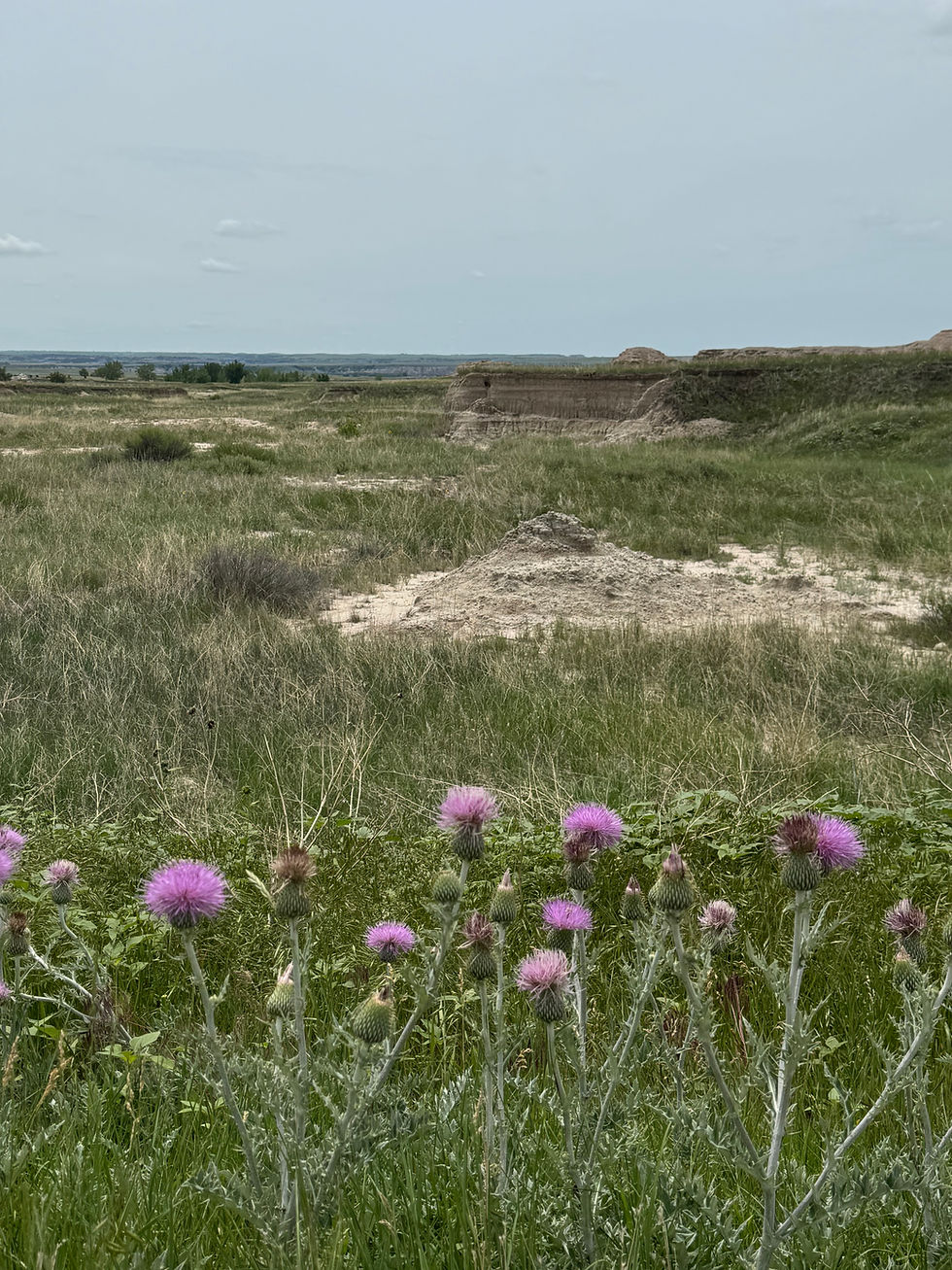
The final hour and a half to Deadwood, where I would be staying for the week, went quickly. The terrain stayed flat until Sturgis, after which it wound up through the beginnings of the Black Hills, which were covered with aromatic pines.
My Airbnb was just a 5-minute walk from downtown Deadwood, a town which has really committed to tourism and gambling for much of its livelihood. I’ve seen a lot of Old West kitsch on my travels, but Deadwood truly does it with aplomb.

I’d chosen Deadwood mostly because I had loved the HBO show of the same name, though I didn’t quite realize when I watched it how much it drew on actual history for its characters and plot. The show’s prolific and gleeful profanity was a metaphor for the town’s actual lawlessness.

Deadwood was a settlement formed on land illegally seized from the Lakota people in 1876, its growth fueled by the Black Hills gold rush. Since it fell outside US jurisdiction, the town operated without traditional law enforcement and had to find its own way through a chaotic existence for a few years until it was laid low by fire, smallpox, and the end of the gold rush. The show is an interesting exploration of morality and societal structure wrapped up in a violent western melodrama.
Here are a few photos comparing the actors from the show with the actual people they portrayed courtesy of subreddit r/deadwood.


After checking in, I showed myself around downtown. Along Main Street there was a bronze statue of a drunk Calamity Jane. There was Saloon No. 10 where Wild Bill Hickok was shot dead while playing poker. There was The Gem saloon, Al Swearengen's joint which featured prominently in the show. And there was the site of the Purple Door Brothel, now an Airbnb, which was closed only 45 years ago in 1980.

I stopped first at Saloon No. 10 and ordered a beer with a whiskey shot - when in Rome. They had no brand name bottles behind the bar and the bartender poured for me out of a nondescript glass bottle. When I knocked it back, I was surprised to find the whiskey tasted watered down.

Apparently the saloon serves spirits distilled the way they were back in the 1870’s when they were much less strong. It now made sense to me how everyone in the show could all consume gallons of the stuff without being incomprehensible stumbling idiots all the time (just some of the time).
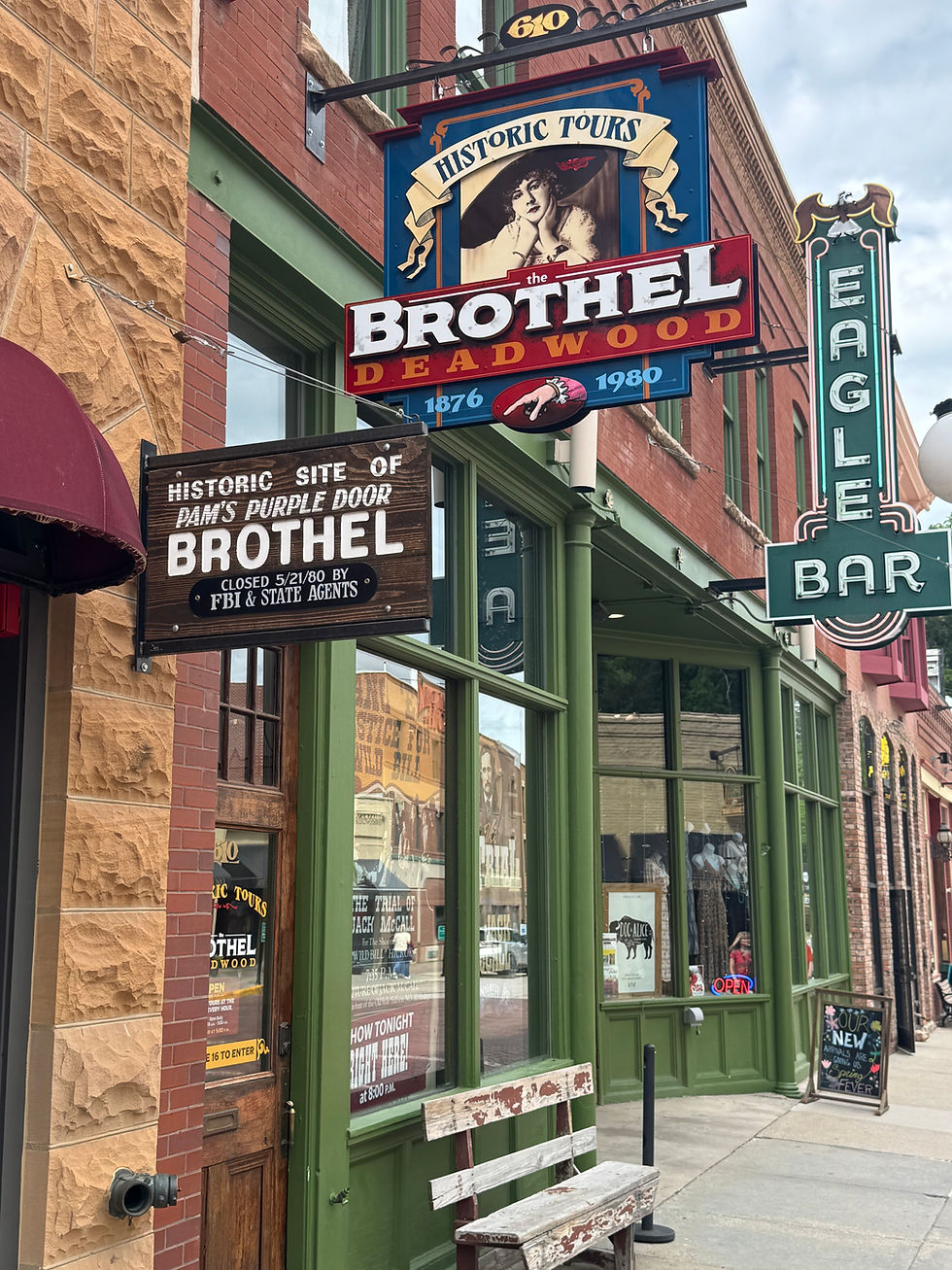
Back out on Main Street I watched as they recreated a duel for the gathered families. Although kinda corny, it was better than Disneyland.
I ducked into Gem to play blackjack but the table games weren't open yet. I almost never play slots, but I made an exception. What the heck, 20 bucks then I’d leave.

Throwing caution to the wind, I hit the Max Bet button and watched the video screen come to life - I hit! My result paid out and gave me 9 free spins which in turn gave me more free spins and resulted in more payouts. All the spins happened automatically. So I basically just sat there for a solid 2-3 minutes while the machine twirled its video wheels, pandas and dragons dancing, pausing periodically to add more to my earnings with its ascending doodle-dee-doodle-dee-doodle-dee-doodle-dee-doodle-dee.
When the machine was finally still, I quit while I was ahead and cashed out with nearly $400.

I decided to treat myself to a big steak dinner in their restaurant upstairs. After, I hit another couple bars along the strip then retired early.

That evening I got a message on Instagram from Steph, my friend Chris’ sister in law - she’d seen my posts from Badlands. She and her family were in South Dakota themselves for a little road trip. I made plans to meet them the following day at Mount Rushmore.
Chris is one of my best and oldest friends. He and I met while studying abroad in Australia in 2000. He was getting his degree in history at the University of Illinois, I was studying business and film at USC.

Chris and I worked together on an extracurricular video project during the semester, editing on an ancient linear Super VHS deck-to-deck system. We had such a great time I convinced him to move to LA after graduation to work on films and TV with me. During the years we were roommates, his parents and siblings became the surrogate wholesome Midwestern family I never had.
BLACK HILLS & SURROUNDING AREA
I made my way to Mount Rushmore in the afternoon the next day - roughly an hour and a half on winding mountain roads past expanses of pine trees and crystal clear lakes.

Mount Rushmore was carved over the course of 14 years starting in 1921. Originally an idea from South Dakota historian Doane Robinson to attract tourism to the remote state, his plan was to depict Old West figures Red Cloud, Lewis & Clark, and Buffalo Bill. He commissioned sculptor Gutzon Borglum who was in the middle of a similar project carving figures into a cliff face on Stone Mountain in Georgia. It was Borglum’s idea to appeal to all of the country by instead carving important US presidents.

The project was originally supposed to cost $250,000 and be funded by private donations, but when President Grover Cleveland visited the site he pledged federal funds for half of the project’s cost, which ran to almost a million dollars. That translates to the modern equivalent of $14 Million dollars, but that still seems like an insane bargain - especially considering it attracts 2.5 - 3 million visitors per year.

In 1941 Borglum died, leaving the project incomplete. He had originally intended to carve the presidents all the way down to their waists and also craft a grand hall of records that would store information about the project and its meaning for thousands of years to come.

Decades after his death, in response to lobbying by his children, the US Government installed a titanium box in the space he had started carving for the hall. Inside the box are a collection of ceramic tiles with information about the sculpture and the people it represents. This area is closed to the public.
I had heard from several people that when they saw Mount Rushmore it was smaller than they had imagined. I didn’t find that to be the case at all. The walk up from the parking lot took me on a wide avenue lined with state flags. The rows of flags drew one’s eyes to and framed the majestic mountain in the distance.

Steph, Adam, and I caught up while the kids ran around the educational exhibits in the visitors center, then we reconvened in Keystone for an early dinner. It was great to see them but I had to cut our time short because I had plans in Deadwood that evening.

That evening I returned to Main Street to attend the Sinsational Cabaret, a weekly burlesque show at the Wild Bill Theater. The theater was...cozy and it filled up halfway by the time the lights were lowered and the music came up.

What the show lacked in production value it more than made up for in talent and charm. The show’s artists, with cheeky names such as Ivanna Spankyou and Rosy Cheeks, delivered inspired performances from feather boa strip teases to aerial twirling, even a fun tango with an invisible man.

The grand finale was a silly and seductive rendition of “Don’t Tell Mama” from the musical Cabaret. I hadn’t expected much of a show, but the performers really delivered, especially considering there’s no way they can be making a living from this little show.
The following morning I traded pasties for pasties (see what I did there?). Drawn in by the name Lou Lou's Bombdiggities Pasties, Espresso and Coffee Shop I went there for my morning coffee. I left with a latte and a steaming pastry filled with two pounds of corned beef, potatoes and sauerkraut called "The Boss". It kept me fed all day.

My first stop was only 10 minutes away in the little town of Lead. I went to the visitors center at the old Homestake Gold Mine. The mine was established in 1876 on land that had been promised to the Lakota people by the Fort Laramie Treaty. Until it closed in 2002, it was the largest, oldest, and deepest mine in the Western Hemisphere. It contained 370 miles (MILES!!) of tunnels going to a depth of 8,000 feet underground.
Hanging at the visitors center was a spindly metal sculpture. It took me a while to figure out what I was looking at, but when I did my jaw hung open. They made a 3D model of the entire mine's tunnel system. The scale was hard to fathom.

The Homestake Mine provided the Hearst Family with their vast fortune. Over the course of its life, it produced 1.24 Million kg of gold. At today’s prices that much gold would be worth around $180 Billion. I wonder how different the country might look today if that land had not been stolen from the Lakota.
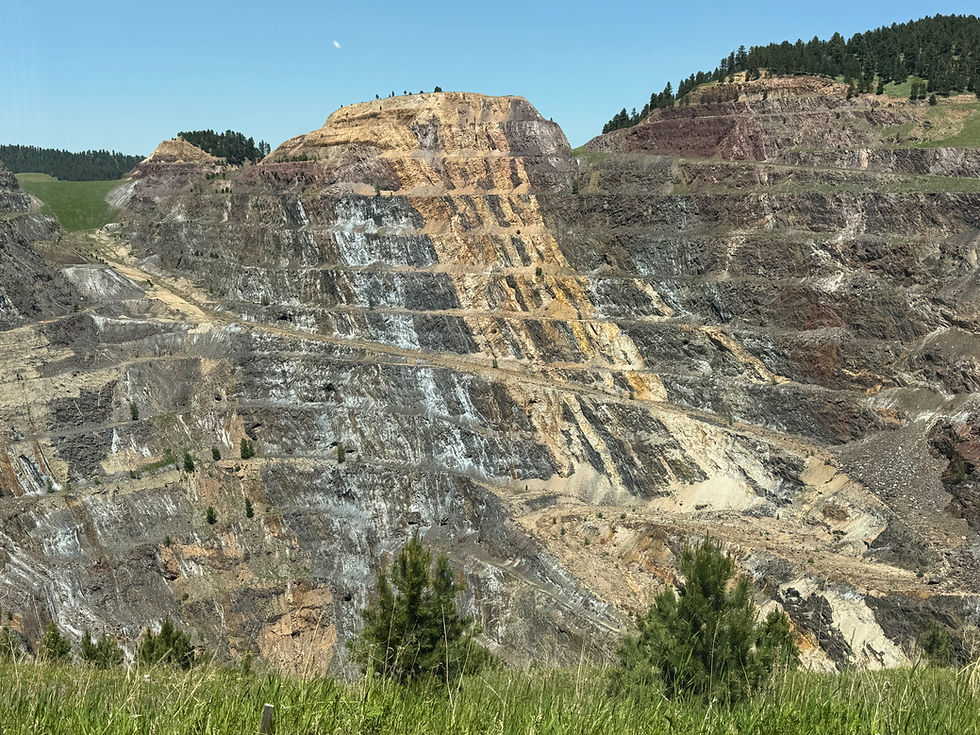
Mining operations were shut down temporarily during WWII. Gold mining was “non-essential”, workers were shipped off to battlefields, and any remaining production capacity went into making planes and bombs.
In the 1960s, physicist Raymond Davis built a 100,000 gallon tank deep down in the mine and filled it with perchloroethylene, a common dry cleaning solvent. He did this so he could detect, far below the earth’s noisy surface radiation, solar neutrinos as they passed through the earth. The Davis Ring stands outside the visitors center to memorialize these original experiments.

If you’re scratching your head right now wondering what that means, I was there with you. Consider this “picture” of the sun taken by a Japanese lab in 1998. To produce this image, they detected the neutrinos produced by nuclear fusion in the solar interior after they passed THROUGH the earth. It took 500 days’ worth of data to make this picture.

Neutrinos are electrically neutral elementary particles and are the most abundant particles in the universe with mass. But here’s the catch - their mass is so infinitesimally small they pass right through objects without interaction, earning neutrinos the name “ghost particles”.
In 2002, the same year that the Homestake Gold Mine was shuttered, Raymond Davis was awarded the Nobel Prize in Physics for the work he did there which, among other things, proved that the sun is powered by nuclear fusion. In 2007 SURF, the Sanford Underground Research Facility, was established in the vacant mine to research neutrinos and dark matter.

I was just barely able, with a lot of googling, to understand neutrinos enough to write a few simple sentences about them. If you're going to ask me what dark matter is you can fuck right off - my puny monkey brain can’t grok it. Apparently dark matter makes up 85% of the universe but we can’t detect it? We only know it exists because we can witness visible objects interact with its gravitational forces. I don't know, trying to think about it just melts my noodle.
Suffice it to say: there are a bunch of really smart people doing groundbreaking work a mile underground in the Black Hills of South Dakota expanding the boundaries of what we understand about the universe.

I spent the rest of the day checking out the cities just outside of the Black Hills. First I ran an errand at the UPS Store in Spearfish. While coordinating the shipping of my package I spoke with James who was working there. I told him about the trip, gave him a sticker, and went on my way. Much to my surprise, James reached out to me a week later. He’d identified with my Emotional States posts, recognizing some of his experiences from his own divorce.

It’s been incredibly moving when strangers tell me that they identify with something I wrote. It makes me feel like this crazy trip has meaning outside of my own noisy skull. James is an amateur photographer himself and shared some of his favorite pictures with permission to post them on the blog.

Every August for the last 86 years, Sturgis, South Dakota has hosted the largest motorcycle rally in the world. This event brings over half a million people - and over half a million vehicles - per year all at once to this remote corner of the country. This single 10-day event contributes $800 million to the state’s economy - roughly 1.3% of South Dakota’s GDP.

The connection is clear when you drive through the area. There are biker bars and biker restaurants, biker lawyers and insurance agents, biker clothing boutiques, bike repair and customizing shops - you name it. There is also the Sturgis Motorcycle Museum and Hall of Fame. I stopped by to check it out, but it was closed for repairs. They were trying to get reopened before the upcoming rally.

Downtown Rapid City was charming but, by the time I got there in the mid-afternoon, it was a windy 104 degrees. I walked around for a short while and checked out a few shops, but it was deserted. The heat had driven everyone inside. I finally followed suit and waited out the heat in an air conditioned movie theater watching 28 Years Later.
I spent several hours on my final day in South Dakota driving through Custer State Park. Narrow roads wound up and down through the Black Hills. Small turn-offs offered me sweeping views of the wooded valleys. Along the spines of the mountain ridges, rock spires stretched up from the conifers to bask in the sun.

There was a little traffic snarl at Sylvan Lake, a popular destination for hikers and those who want to kayak the small, tranquil lake past the looming granite structures along its shore.

Just past Sylvan Lake I had to wait my turn at Needles Tunnel, a single car-width channel cut through the rock at the top of the mountain. Once through, the next turnoff offered the most stunning views yet.
After 40 more minutes winding my way back down the far side of the mountain, I arrived at the start of the 18-mile Wildlife Loop Road. Much of the next couple of hours was spent in stop and go traffic within or between bison herds.

Hundreds of the huge gentle creatures grazed on either side of the road, lounging in the sun. When they felt like crossing the road, they crossed the road. Between herds of bison were wide open fields, some dotted with wild horses, antelopes roaming others.

I exited Custer Park in the mid afternoon sun and pointed Pierogi north. Very quickly after passing Sturgis, the landscape flattened out. My last 150 miles in the state looked about like what I’d originally been expecting. I was glad I'd been wrong. South Dakota had been a real stunner.

I had no reason to doubt what everyone had told me - that North and South Dakota are very different. But I didn't have to take others’ word for it - I was about to see for myself.
Yes, and…
Matt


Comments