Physical State of Matt #38: RHODE ISLAND
Updated: Aug 29
"Rhode Island is neither a road nor an island. Discuss…” This indelible line, uttered by Linda Richman on her show Coffee Talk runs through my head every single time I hear the state's name.
Coffee Talk, or more accurately “Cawfee Tawk” was, of course, a skit on Saturday Night Live with Mike Meyers as Linda Richman. The skit was such a hit they did it 17 times with different guest hosts doing horrendous Long Island accents. This was during the second heyday of SNL in the mid-90’s, unsurpassed by any but the original cast. It was like buttah. I'm getting a little verklempt...
The origin of the Rhode Island's name is actually uncertain. Some attribute it to Italian explorer Giovanni da Verrazzano and others to Dutch explorer Adriaen Block, but in both theories they likened one of the islands along the coast to the Greek island of Rhodes in the Aegean Sea. Its first use in print was English colonist, and Rhode Island founder, Roger Willams who wrote “Aquethneck shall be henceforth called the Ile of Rods or Rhod-Island.”

Rhode Island is the smallest state in the Union, so I had a limited choice of cities in which to stay. Its two most prominent cities are Providence and Newport. Accommodations in Newport were crazy expensive for the summer, so I picked Cranston, a suburb of Providence. A bit of a cheat, especially considering I’d been to Providence before, but my trip, my rules.
My first trip to Providence was one I will never forget, and one that secured my love for the Mighty Mighty Bosstones. The Bosstones were a ska-core band that first introduced me to 3rd Wave Ska, a musical genre I love to this day. Their raucous combination of punk rock, reggae, and horns struck a nerve. It was commonplace at their early shows for a sweaty kid to climb out of the pit onto the stage, sing a line or two into the mic, then launch himself onto the crowd. I did my first stage dive at one of their shows.
I was 14 the first time I went to see them at Max’s, a small club in Ithaca that regularly had all ages punk and hardcore shows. I begged, pleaded, and fought my mom to let me go. She finally relented on one condition - she would pick me up at 10:00 and not a minute later. The Bosstones didn’t go on until 10:05, and I was butt-hurt as hell that I had to leave. Since then, I’ve seen them probably a dozen times, so I suppose I've compensated for that colossal injustice.
I was visiting friends near Boston in early 1995 and had just turned 19. I heard that the Bosstones were playing Providence the following day, so I called the venue - the late Lupo’s Heartbreak Hotel. The recording on the voicemail said “We are sold out for the St. Patty’s Day Bash - as in out of tickets. Don’t leave a message, don’t even bother. We are out.” There was also the minor problem of being underage - and I never had a fake ID.

I’m not sure if I was stubborn, deluded, dumb, or d) all of the above, but I booked a train in the morning. I’d either figure something out…or I wouldn’t. I arrived in Providence in the afternoon and found the venue. They weren’t open yet, but the front door was propped open and I could hear music coming from inside. No one noticed as I walked in and up to the stage, where I watched the Bosstones perform soundcheck.
Afterward, the lead singer Dicky Barrett approached me and introduced himself. He invited me back to their dressing room and handed me a Sam Adams Boston Lager. When he learned that I didn’t have a ticket he put me on their guest list. Not only had I scored an entry to the show, but I’d managed to do it in a way that they wouldn’t ask me for ID.

He was instantly my hero and this experience cemented them as my favorite band. They had one giant hit with “The Impression That I Get”, which reached #1 on the charts, the year before I moved to LA. They are widely considered a one-hit wonder, but I consider that blasphemy.
It broke my heart when Dicky came out as an anti-vaxer. He departed his job as the announcer on Jimmy Kimmel Live, a job he’d held for 20 years, after ABC mandated vaccines for all workers on their shows. This stance and his shifting politics was a major factor in the band's break up in 2022. Why is it that so many cool people become right-wing cranks in their old age?

That trip had been my only time in Providence so the city had a special place in my heart since. The scene replayed in my head as I made the 350 mile drive from Montreal, with a pitstop at the Ben & Jerry’s factory in Waterbury, VERMONT.

I got a hotel east of the city the first night so I could grab coffee with my friend Brad, who I'd visited for my MASSACHUSETTS stop. He was leaving for his annual drive back to LA from Martha’s Vineyard with his golden retrievers Bear and Buffy. We met at Gathering Grounds, a charming cafe/bookstore on the edge of the unfortunately named Old Grist Mill Pond.

I got an early check-in for my Airbnb in Cranston, and went to downtown Providence in search of an early lunch. After getting spun around looking for street parking, I finally arrived at the Small Point Cafe. I settled into the comfy seating area with my latte and sandwich and started writing. Some time later the woman at the next table asked me if I could keep an eye on her stuff while she went to the bathroom. And this is how I met Carolina.
We started talking when she got back, and it turned out that she also worked remotely doing software sales. Her other gig was teaching dance in Las Vegas, but she had taken the summer off to travel the east coast. She had already been in Providence for a couple of weeks staying with a friend. She was a pastry connoisseur and recommended several coffee shops around town with amazing baked goods. We agreed to meet up sometime later in the week.

I took it easy for the rest of the day and did some laundry. I found a 1000-piece jigsaw puzzle in the closet and decided to do it. I have always had a knack for jigsaw puzzles. Even as a toddler I was doing complicated puzzles. When I focus on them the world drifts away and I enter a flow state. It’s the same as the feeling I get when I paint miniatures.

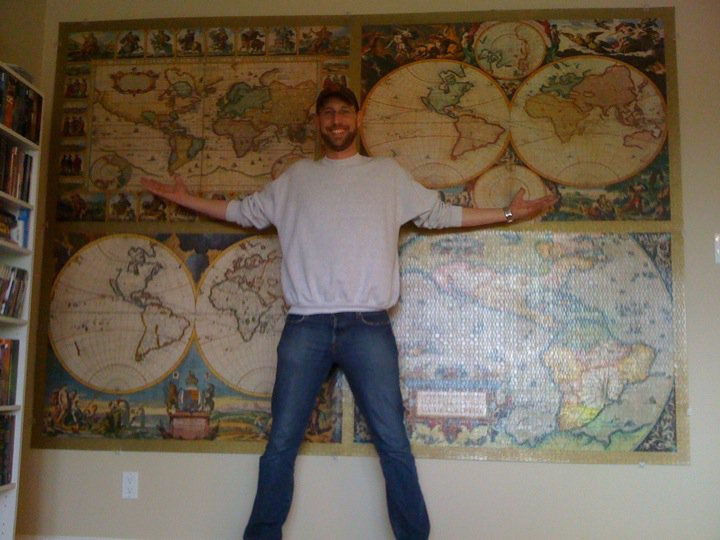
I kept doing puzzles throughout my 20s and early 30s and sought out more and more challenging puzzles. My pinnacle was an 18,000 piecer, which took me about a year to complete (not working continuously). To be fair, it came in four separate bags so it was actually four 4,500-piece puzzles that all connected, but still. I documented the process on my iPhone 3 (hence the shitty quality of the pictures).
When I was done, I glued the beast together on foamcore board and hung it. It took up the whole wall. After a couple of moves it started falling apart, so I eventually tossed it. After my former partner moved in with me, I stopped doing puzzles because I was now sharing the house with a cat and a dog. When I sat down in Rhode Island and opened the box, it occured to me that it had been close to 15 years since I’d puzzled. For shits & giggles I decided to time myself. I finished it in an hour and 53 minutes. Nice to know I’ve still got it.
That night was the premiere of Alien: Earth. As anyone who has read my GEEKY post knows, I am a diehard fan of the Alien universe. I’d been eagerly anticipating Alien: Earth, the first television show of the franchise, for months. I popped corn, and watched the first two episodes with rapt attention. After a couple of hours to digest the show and watch the Perfect Organism (my Alien Podcast) aftershow livestream, I promptly watched them again.

Halfway through the second episode I saw movement out of the corner of my eye. I had been so still watching TV in the dark that a tiny mouse had decided it was safe to venture out into the living room. As soon as I reached for my phone to get a picture it scurried away.
PROVIDENCE
I explored Providence the next day, starting with the Providence Athenæum (after the Greek goddess Athena). I was dazzled as I walked into the library’s front door. Sun beamed through the plentiful skylights, illuminating two floors of endless books. Another staircase led down to even more books and a cozy reading room.

The athenæum has been around for nearly 200 years. It has an impressive collection, including art and rare books such as Description de l’Egypte, a 23-volume set accounting Napoleon’s expedition to Egypt. It also has its own rich history. The Providence-based poet Sarah Helen Whitman had a special connection with the library throughout most of her life. Edgar Allen Poe traveled to Providence to court her and visited the athenæum frequently.
(photos from Edgar Allen Poe RI)
True to his brand, Poe proposed to her in a local cemetery (though it's unclear which one). They had a rocky engagement and never ended up marrying. They were sitting together in the athenæum when a messenger delivered a note to Whitman that revealed Poe had broken his promise of sobriety and had been drinking behind her back. She broke off the engagement and Poe died within a year.
I don't know if it's the silence or perhaps the smell but there is something soothing about walking through stacks of books. Since I started this trip I have had difficulty focusing on reading, though I have consumed plenty of audio books on the road. I hope, when the writing is done, that I’ll be able to return to reading as it has brought me so much pleasure throughout my life.

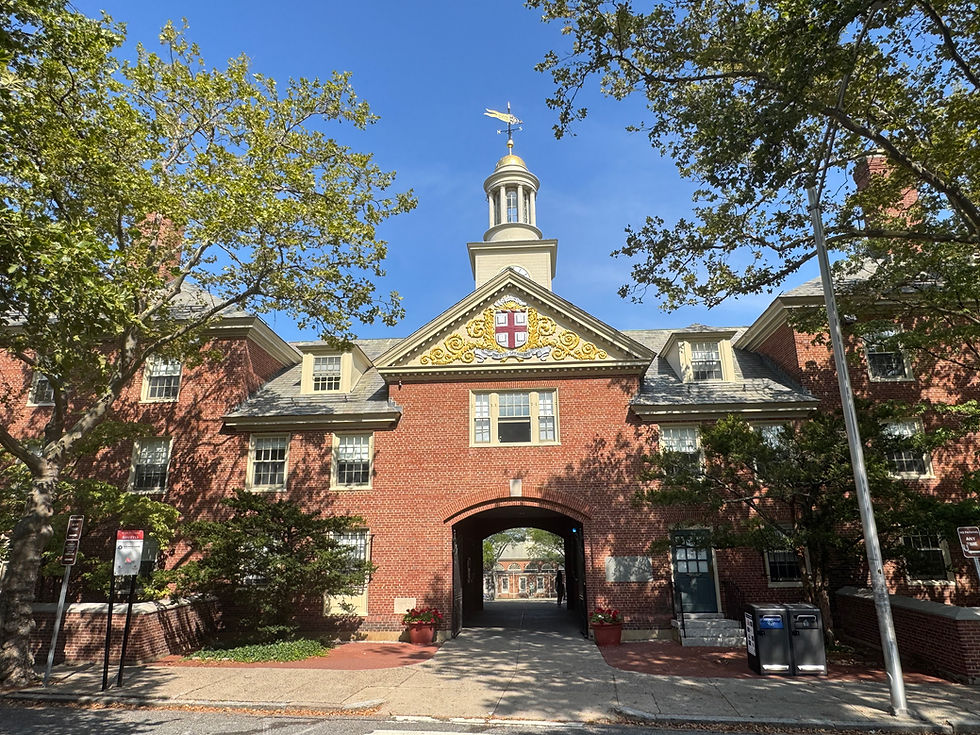
Providence is home to Brown University. Having grown up around Cornell, I know well how beautiful it can be to wander around the campus of an Ivy League school.

The sun was shining and it was orientation week, so clusters of incoming students and their parents were being toured around the various buildings of campus. I wandered aimlessly for a while, admiring the architecture and scupltures. I finally found my way to Thayer Street, the main commercial drag through the Brown neighborhood, and had succulent Korean fried chicken at Den Den.
I took a short drive over to Prospect Terrace. On the way found the road obstructed by the last thing I would have expected - a wild turkey. She was taking her sweet-ass time just moseying down the middle of the street.

Though I'd never seen it, wild turkeys have been overrunning college campuses all over the country. They were nearly extinct at the start of the 20th century, but conservation laws made it possible for them to come back. Now it’s estimated that there are around 7 Million in the US, in every state but Alaska. College campuses have proved to be an ideal habitat for them with their mixture of wooded areas and open grassy space - and no hunters of course.
Prospect Terrace was a small park featuring an imposing arch and statue with a panoramic view of the city. The arch and statue were erected to honor the aforementioned Roger Williams. Williams was originally a Puritan minister, but was expelled by church leaders in the Massachusetts Bay Colony when he questioned the church’s authority to force religious conformity.

Roger Williams formed Providence Plantations in 1636 with the tenet of “liberty of consciousness”. Providence Plantations evolved and eventually became Rhode Island, making the state the first government in the Western world to guarantee freedom of religion in its charter. His ideas and example influenced the First Amendment to the US Constitution 155 years later.

Other statues of Williams around Providence depict him with an outstretched and upturned “welcoming” hand to symbolize his philosophy of religious tolerance. Unlike the other statues however, the one at Prospect Terrace has his palm facing down. Rather than welcoming he looks like he’s explaining how tall you have to be to ride the rollercoaster.

Williams’ remains, as they are, reside in a bronze casket beneath the statue. Because he had established a clear separation between church and state in Providence Plantations, there was no public cemetary when he died in 1683. He was buried in a modest plot alongside an orchard on his own land.
Williams was exhumed 177 years later to move him to a site more befitting of his legacy. It was discovered that the roots of an apple tree had grown through his body, roughly following its outline. Not much was left of the man himself, so dirt and bone flecks from the grave were moved to a mausoleum in the North Burial Ground. These remains were moved again to Prospect Terrace when the monument was built in 1939.

The “Williams Root” is on display a few blocks from the park at the John Brown House. To say that it looks like a person seems like a stretch to me, but every famous figure needs their mythology I suppose.

Despite Wililams’ substantial legacy, the most famous person from Providence is almost certainly the severe looking gothic horror and fantasy author Howard Phillips Lovecraft. H.P. Lovecraft is best known for creating the Cthulhu Mythos and the fictional town of Arkham. His tome The Necronomicon (roughly, “The Book of the Dead”) explains much of his world's mythology.

Cthulhu, the eponymous creature of the universe in which many of his stories were set, was introduced in Lovecraft’s “The Call of Cthulhu”, fist published in “Weird Tales” in 1928. It is:
“a monster of vaguely anthropoid outline, but with an octopus-like head whose face was a mass of feelers, a scaly, rubbery-looking body, prodigious claws on hind and fore feet, and long, narrow wings behind.”

The term “Cthulhu Mythos” was actually coined later by others. Lovecraft himself referred to his interconnected works as the “Arkham cycle”. Arkham is the fictional town in Massachusetts he first introduced in his short story “The Picture in the House”. It appeared in 13 of his stories in all. Younger audiences may recognize Arkham Asylum, so named in homage, where Batman’s colorful villains are held when they are captured.

Unlike Edgar Allen Poe, one of his influences, Lovecraft died in poverty and obscurity. Toward the end of his life, as his family trust ran out, he often skipped meals to use the money instead for postage to submit his writing. Apart from some of his short stories, his only book that was published in his lifetime was "The Shadow Over Innsmouth". It sold only 200 copies. He died at 46 from intestinal cancer.

His works and influence loom so large now it seems odd that he remained relatively unknown until the 1970s. Cheap paperback reprints of his works developed a cult following in the 60s counterculture scene. In 1975 his first biography, written by L. Sprague de Camp, was published.
His work broke into mainstream consciousness in the 1980’s when the Call of Cthulhu role-playing game was firsgt published and modern horror writers Stephen King and Neil Gaiman referenced him as an influence. Today there is a branch of literary academics called Lovecraft studies.

H.P. Lovecraft’s horror legacy may be beloved, but the man himself was a problematic figure. He was a despicable racist and white supremacist. In his personal correspondence he praised Hitler as a patriot and argued that an “absolute color-line” was necessary to prevent Negro (a “vastly inferior biological variant”) blood from tainting Aryan stock. African Americans were presented as criminal, savage, or demonic in his fiction. His poem “On The Creation of Ni**ers” pretty much sums up his views.

His notorious racism inspired Matt Ruff, whose first novel “Fool on the Hill” was set at Cornell in my hometown of Ithaca, to write “Lovecraft Country” in 2016. The book interweaves Lovecraft’s horror themes and imagery with stories of the racist treatment of an African American man, Atticus Turner, in the Jim Crow Era. The book was adapted into an HBO series in 2020.
I myself have never read Lovecraft, partly because of his vile views, but as a lover of horror I did go see some of the sights while in town. Providence has several Lovecraft-related locations marked around the city. Among these were the Lovecraft Memorial Square on Brown Campus and the house in which he lived for the last 4 years of his life.

I also tracked down his grave in Swan Point, a sprawling 200-acre cemetery along the shore of the Seekonk River in the northern part of the city. From the parking lot it took me 20 minutes of searching on foot to find the Phillips family plot. H.P.’s gravestone is a modest thing, especially considering the many towering monuments that surround it.

The lettering on his stone was faint from decades of curious hands, and a truly ecclectic collection of objects rested on and around it. There were stones, coins, and acorns. There was also an earplug, a guitar pick, and a koala-headed rubber ducky from Outbank Steakhouse. It was as if people found the grave, felt compelled to make an offering, and left whatever they had in their pockets.
NEWPORT
The following day I drove down to Newport, a large island between Narragansett Bay and the Atlantic Ocean. The late morning sun beat down on the beach through wispy clouds. A thick, low-hanging fog obscured the first thirty feet above the water and shore.

I embarked upon the Cliff Walk, a popular 3.5-mile path along the shore. in the distance, across the water, a church tower and the tops of trees poked out above the mist. The path started atop a cliff overlooking the water, then made its way down along the shore. Waves crashed against the seawall, at points spraying across the path, soaking hikers.

Along the other side of the path the stately buildings of Salve Regina University stood sentry.

The University buildings gave way to private mansions. Some were modern Cape Cod constructions, and some were ostentatious old money behemoths.

The crowd dwindled as the path became increasingly rough. More and more frequently, I was forced to clamber over massive rocks to reach the next paved section. Maintenance of the path is privately funded with charitable donations, but I got the sense that the owners of the mansions would be happy to lose the crowds of plebs who marched daily along the edges of their finely manicured grounds.

At points, echoey pedestrian tunnels lined with corrugated metal ran underneath rock outcroppings with buildings atop them.

One such building was the striking Chinese Tea House, whose roof dragons and flying eaves were visible from a distance. The tea house is open to the public with a reservation and sits on the grounds of the Vanderbilt Marble House.

The 50-room Marble House was built by William K. Vanderbilt for his wife Alva as a 39th birthday present. Its style was inspired by the Petit Trianon at Versailles and cost $11 Million, 7 of which went toward 500,000 cubic feet of imported marble. They were divorced three years after construction completed, which must have stung. Then again, when you have more money than god, what’s a 140,000 square-foot seaside mansion here or there?

Alva (now Belmont) had the tea house built in 1914. She became a prominent figure in the women's suffrage movement and used it to host meetings. The Prince Family owned the property from 1932 to 1963 when Harold Stirling Vanderbilt bought it back to donate it to the Preservation Society of Newport County which now operates it as a museum.

Just past the tea house, the soothing lapping of waves was interrupted by the rhythmic thudding of what I can only assume was a private helicopter landing on the ample lawn of one of the estates.

The Cliff Walk ended at The Breakers, a monumental historic mansion with sweeping views of the ocean. The preservation society purchased it from the heirs of Countess Gladys Széchenyi, the daughter of original owner, Cornelius Vanderbilt II, in 1972 for a mere $365,000, which is crazy. That would barely buy you a parking spot in Manhattan today.

Across from The Breakers was the sweeping Bailey’s Beach East. I was surprised to learn that it’s a public beach. The land was granted to the city for public use in 1970. In contrast to the neighboring Bailey’s Beach, a very exclusive private beach, Bailey’s Beach East is colloquially known by locals as “Public’s Beach” or “Rejects Beach”. Lovely.

I was getting properly baked by the sun, so I opted to walk back through the tree-lined streets of the neighborhood. Some of the mansions were on full display from the street, while others hid behind twenty-foot hedges. The Preservation Society of Newport County operates 11 mansions, but most of the rest are still private residences.

One of the houses was having a garden party. Guests parked at a distant lot and were shuttled to the property by a gleaming horse-drawn carriage, complete with a uniformed footwoman. It was kinda fun and also absolutely ridiculous. The ultra rich really do live differently from us.
I eventually arrived back in downtown Newport. I spotted the International Tennis Hall of Fame. But, being sweaty and worn out after my 7-mile walk, I didn’t bother with it. Besides, I never cared much for tennis anyway.

That evening I met Carolina for dinner at Rooftop at the Providence G, a casual elegant lounge atop a luxury apartment building downtown. Carolina had brought her roller skates and invited me to the outdoor roller disco event she was planning to attend at the Providence Rink.
I used to be a halfway decent roller skater when I was much younger, but I haven’t done it in years. I politely declined, certain I was likely to simply break my ass.
The sunny evening air was the perfect temperature. From our seats we could see the prominent Industrial National Bank Building, known locally as the Superman Building due to its resemblance to the Daily Planet where Clark Kent worked in the 1950s TV Show.
The light began to fade, and as Carolina and I chatted over a post-dinner cocktail, chef Nic came to see if we’d enjoyed our meal. Having spent years cooking professionally, kitchen workers are my people. We both hit it off with the gregarious Nic immediately. He sat down with us and spent probably thirty minutes sharing stories of growing up in Asia and the Middle East.

We talked food and swapped stories of alcohol-fueled debauchery from our younger years, but it was quickly apparent that mine paled in comparison to his. Each piece of heavy machinery, he explained, operates with one of about 20 master keys, and he used to have a complete set. He told me about one time when he "borrowed" a scissor life and took it for a drunken joyride down the Vegas Strip. I was never that wild.

He sent us both away with slices of a dessert he had been experimenting with - cheesecake made with ube (a Southeast Asian purple yam) and yuzu (a Japanese citrus fruit).
Right when Carolina and I stood up to leave, we felt the first drops of rain. The rooftop began to clear out. By the time we made it down to the lobby the rain was coming down in heavy sheets. Roller skating plans dashed, Carolina called an Uber. She offered to drop me at my car six blocks away, but I love a good summer rain so I walked instead.

Within a block I was soaked through, but the evening was still warm. I walked to my car at a leisurely pace, taking in the charming city, its lights diffused by the downpour. When I finally made it to my car, I made a half-assed attempt to wring out my shirt and drove home through four-inch deep puddles that covered the roads.
The following morning, my car seat still rather damp, I stopped at the Rise n’ Shine Coffee Bar on my way out of town. Carolina’s pastry research paid off with a killer scone for breakfast with my latte. The walls of the cafe were adorned with wooden shoe molds in honor of the building's history as a cobbler shop.

Rhode Island is small, but it has a lot to offer. My fondness for Providence deepened during my time there. With only twelve more states to go, I started out on what was supposed to be a short drive west to my final New England state - Connecticut.
Yes, and…
Matt


Comments